2. child a weighs 225 n and sits 1.0 m from the pivot of an adjustable seesaw. if child b weighs 176 n, how…
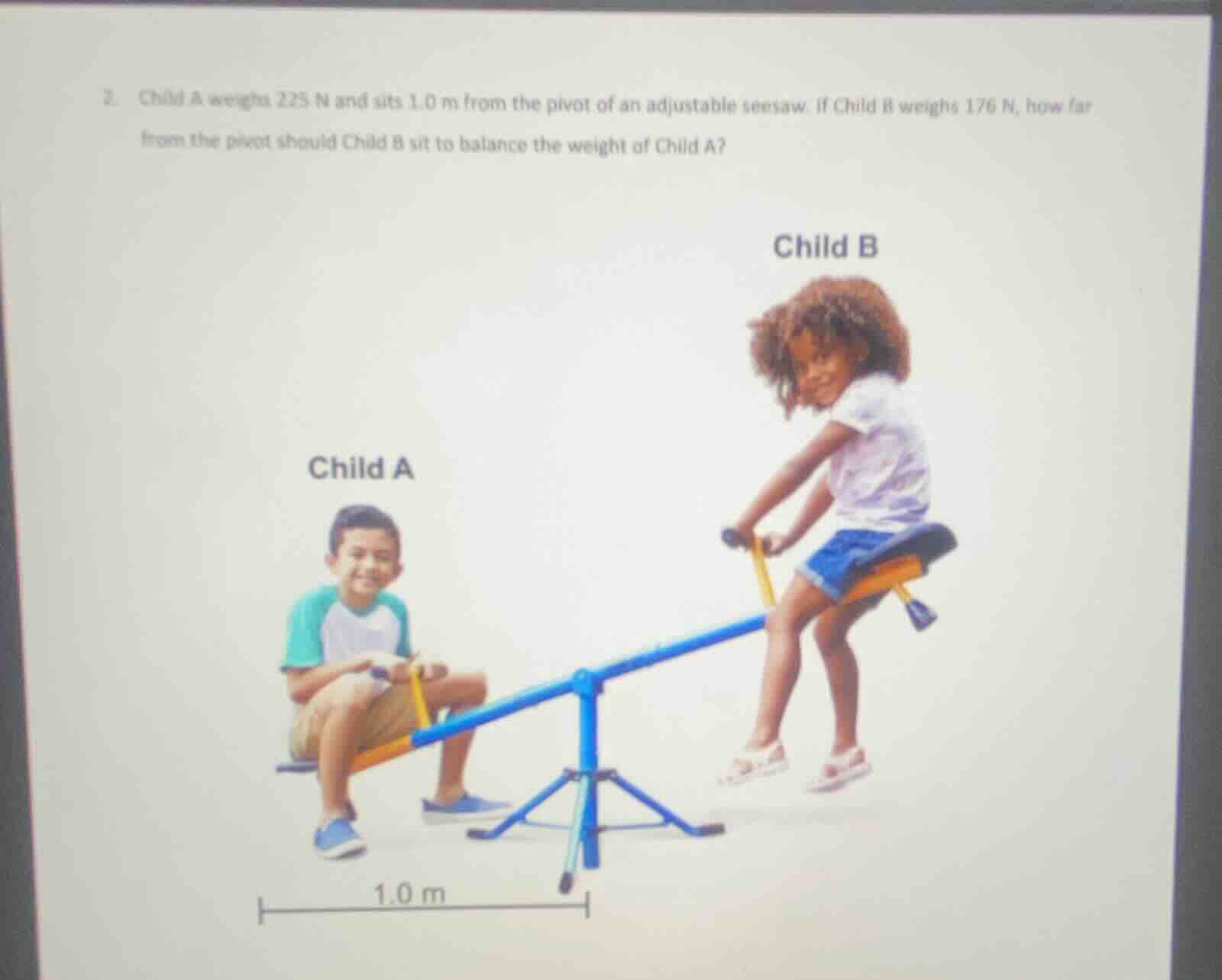
2. child a weighs 225 n and sits 1.0 m from the pivot of an adjustable seesaw. if child b weighs 176 n, how far from the pivot should child b sit to balance the weight of child a?
Answer
Explanation:
Step1: Recall the principle of moments (torque balance) for a seesaw. The principle states that for the seesaw to be balanced, the clockwise moment must equal the counter - clockwise moment. The moment ( M ) is given by the formula ( M = F\times d ), where ( F ) is the force (weight in this case) and ( d ) is the distance from the pivot. Let the weight of Child A be ( F_A = 225\ N ), the distance of Child A from the pivot be ( d_A=1.0\ m ), the weight of Child B be ( F_B = 176\ N ), and the distance of Child B from the pivot be ( d_B ) (which we need to find). For balance, ( F_A\times d_A=F_B\times d_B ).
Step2: Rearrange the formula to solve for ( d_B ). We get ( d_B=\frac{F_A\times d_A}{F_B} ).
Step3: Substitute the given values into the formula. ( F_A = 225\ N ), ( d_A = 1.0\ m ), and ( F_B=176\ N ). So ( d_B=\frac{225\ N\times1.0\ m}{176\ N} ).
Step4: Calculate the value. ( \frac{225\times1.0}{176}=\frac{225}{176}\approx1.28\ m ).
Answer:
Child B should sit approximately ( 1.3\ m ) (or more precisely ( \frac{225}{176}\approx1.28\ m )) from the pivot.