a chord consists of notes that sound good together. the c major chord, starting at middle c, has the…
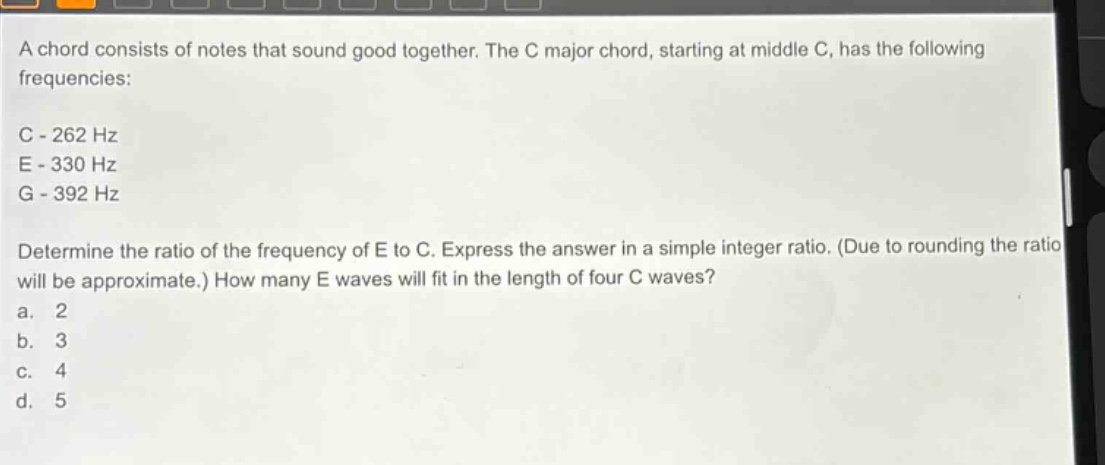
a chord consists of notes that sound good together. the c major chord, starting at middle c, has the following frequencies:\nc - 262 hz\ne - 330 hz\ng - 392 hz\ndetermine the ratio of the frequency of e to c. express the answer in a simple integer ratio. (due to rounding the ratio will be approximate.) how many e waves will fit in the length of four c waves?\na. 2\nb. 3\nc. 4\nd. 5
Answer
Explanation:
Step1: Find the ratio of frequencies
The frequency of (C) is (f_C = 262\space Hz) and the frequency of (E) is (f_E=330\space Hz). The ratio of frequencies (\frac{f_E}{f_C}=\frac{330}{262}\approx\frac{3}{2}) (after simplification).
We know that the speed of a wave (v = f\lambda) (where (v) is the speed of sound, (f) is the frequency and (\lambda) is the wavelength). Assuming the speed of sound (v) is constant (since the medium is the same), (\lambda=\frac{v}{f}).
Let the wavelength of (C) be (\lambda_C) and of (E) be (\lambda_E). Then (\frac{\lambda_C}{\lambda_E}=\frac{f_E}{f_C}) (because (v = f_C\lambda_C=f_E\lambda_E))
Step2: Calculate the number of (E) waves in 4 (C) waves
Let (n) be the number of (E) waves. We know that (4\lambda_C=n\lambda_E). From (\frac{\lambda_C}{\lambda_E}=\frac{f_E}{f_C}\approx\frac{3}{2}), we can rewrite (4\lambda_C=n\lambda_E) as (n = 4\times\frac{\lambda_C}{\lambda_E})
Substitute (\frac{\lambda_C}{\lambda_E}\approx\frac{3}{2}) into the equation: (n = 4\times\frac{3}{2})
[n=\frac{12}{2}=6] (Wait, no. Let's use another approach.
Since (v = f\lambda), for a given length (L), (L = N\lambda). Also, (v) is constant. So (f_1\lambda_1=f_2\lambda_2). If (L = 4\lambda_C), and (L=n\lambda_E), then (4\lambda_C=n\lambda_E). Since (f_C\lambda_C = f_E\lambda_E), (\lambda_E=\frac{f_C}{f_E}\lambda_C). Substitute into (4\lambda_C=n\lambda_E):
(4\lambda_C=n\times\frac{f_C}{f_E}\lambda_C). Cancel out (\lambda_C) (since (\lambda_C\neq0)). (n = 4\times\frac{f_E}{f_C})
Substitute (f_C = 262), (f_E = 330): (n=4\times\frac{330}{262}\approx4\times1.26\approx 5)
Answer:
d. 5