a circuit contains two light bulbs connected in parallel. what would happen to the brightness of each light…
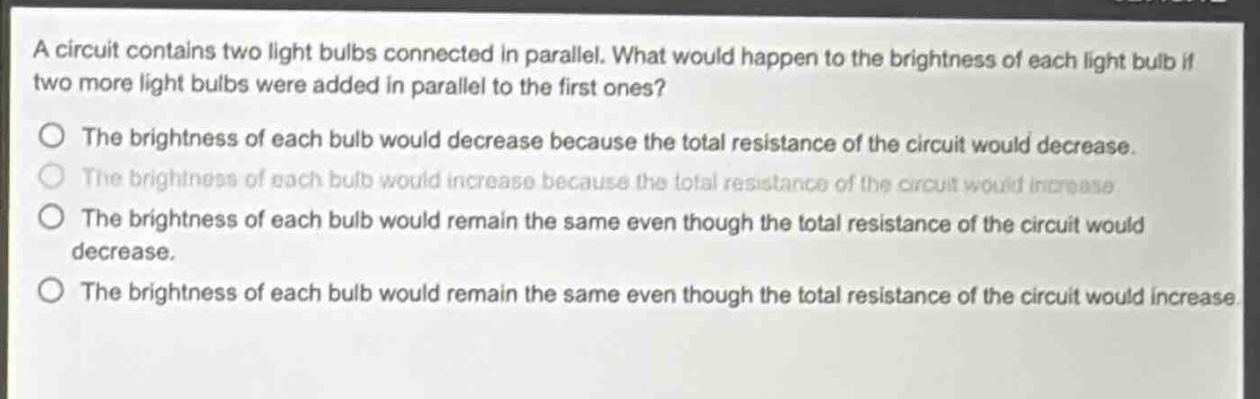
a circuit contains two light bulbs connected in parallel. what would happen to the brightness of each light bulb if two more light bulbs were added in parallel to the first ones?\nthe brightness of each bulb would decrease because the total resistance of the circuit would decrease.\nthe brightness of each bulb would increase because the total resistance of the circuit would increase.\nthe brightness of each bulb would remain the same even though the total resistance of the circuit would decrease.\nthe brightness of each bulb would remain the same even though the total resistance of the circuit would increase.
Answer
Answer:
The brightness of each bulb would remain the same even though the total resistance of the circuit would decrease.
Explanation:
Step1: Comprender los circuitos en paralelo
En un circuito en paralelo, el voltaje en cada componente es el mismo.
Step2: Analizar la resistencia total
Cuando se agregan más componentes en paralelo, la resistencia total del circuito disminuye. La fórmula para la resistencia total $R_{total}$ de $n$ resistencias $R_1, R_2,\cdots, R_n$ en paralelo es $\frac{1}{R_{total}}=\sum_{i = 1}^{n}\frac{1}{R_i}$.
Step3: Analizar la potencia de cada bombilla
La potencia de una bombilla $P=\frac{V^{2}}{R}$, donde $V$ es el voltaje y $R$ es la resistencia de la bombilla. Dado que el voltaje $V$ en cada bombilla en un circuito en paralelo no cambia (independientemente del número de bombillas agregadas en paralelo) y la resistencia $R$ de cada bombilla individual no cambia, la potencia $P$ de cada bombilla no cambia. Y la brillantez de una bombilla está relacionada con su potencia, por lo que la brillantez de cada bombilla permanece igual.