a circuit contains two light bulbs connected in parallel. what would happen to the brightness of each light…
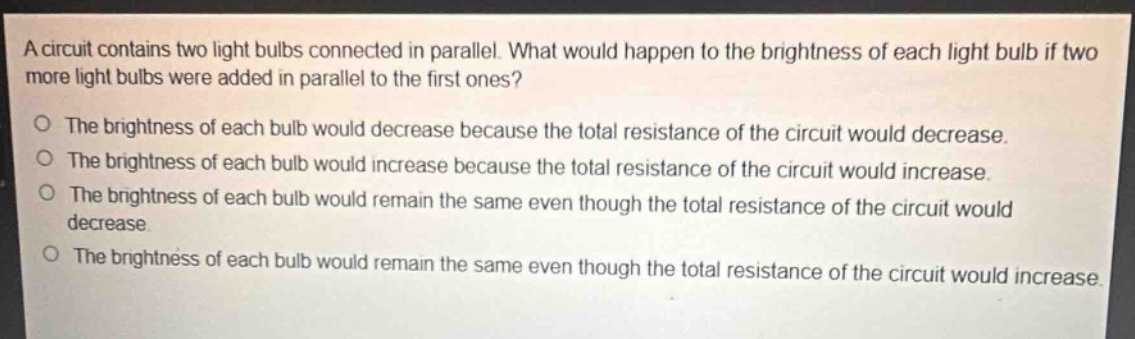
a circuit contains two light bulbs connected in parallel. what would happen to the brightness of each light bulb if two more light bulbs were added in parallel to the first ones?\no the brightness of each bulb would decrease because the total resistance of the circuit would decrease.\no the brightness of each bulb would increase because the total resistance of the circuit would increase.\no the brightness of each bulb would remain the same even though the total resistance of the circuit would decrease.\no the brightness of each bulb would remain the same even though the total resistance of the circuit would increase.
Answer
Answer:
The brightness of each bulb would remain the same even though the total resistance of the circuit would decrease.
Explanation:
Step1: Understand parallel - circuit voltage
In a parallel - connected circuit, the voltage across each component is the same. Let the voltage of the power source be $V$. For each light - bulb, the voltage across it is always $V$ regardless of the number of bulbs added in parallel.
Step2: Analyze power formula
The power dissipated in a light - bulb is given by $P=\frac{V^{2}}{R}$, where $V$ is the voltage across the bulb and $R$ is the resistance of the bulb. Since the resistance of each individual bulb $R$ remains constant and the voltage $V$ across each bulb remains constant (because of the parallel - circuit property), the power $P$ of each bulb remains the same.
Step3: Relate power and brightness
The brightness of a light - bulb is directly related to the power dissipated in it. Since the power of each bulb remains the same, the brightness of each bulb remains the same.
Step4: Consider total resistance
The formula for the total resistance $R_{total}$ of a parallel circuit with resistors $R_1,R_2,\cdots,R_n$ is $\frac{1}{R_{total}}=\sum_{i = 1}^{n}\frac{1}{R_i}$. When more bulbs (resistors) are added in parallel, the total resistance $R_{total}$ of the circuit decreases. But this does not affect the voltage and power of each individual bulb.