for the circuit diagram below, the source has a voltage of 6.0 v. each resistor has resistance 12.0 ω. find…
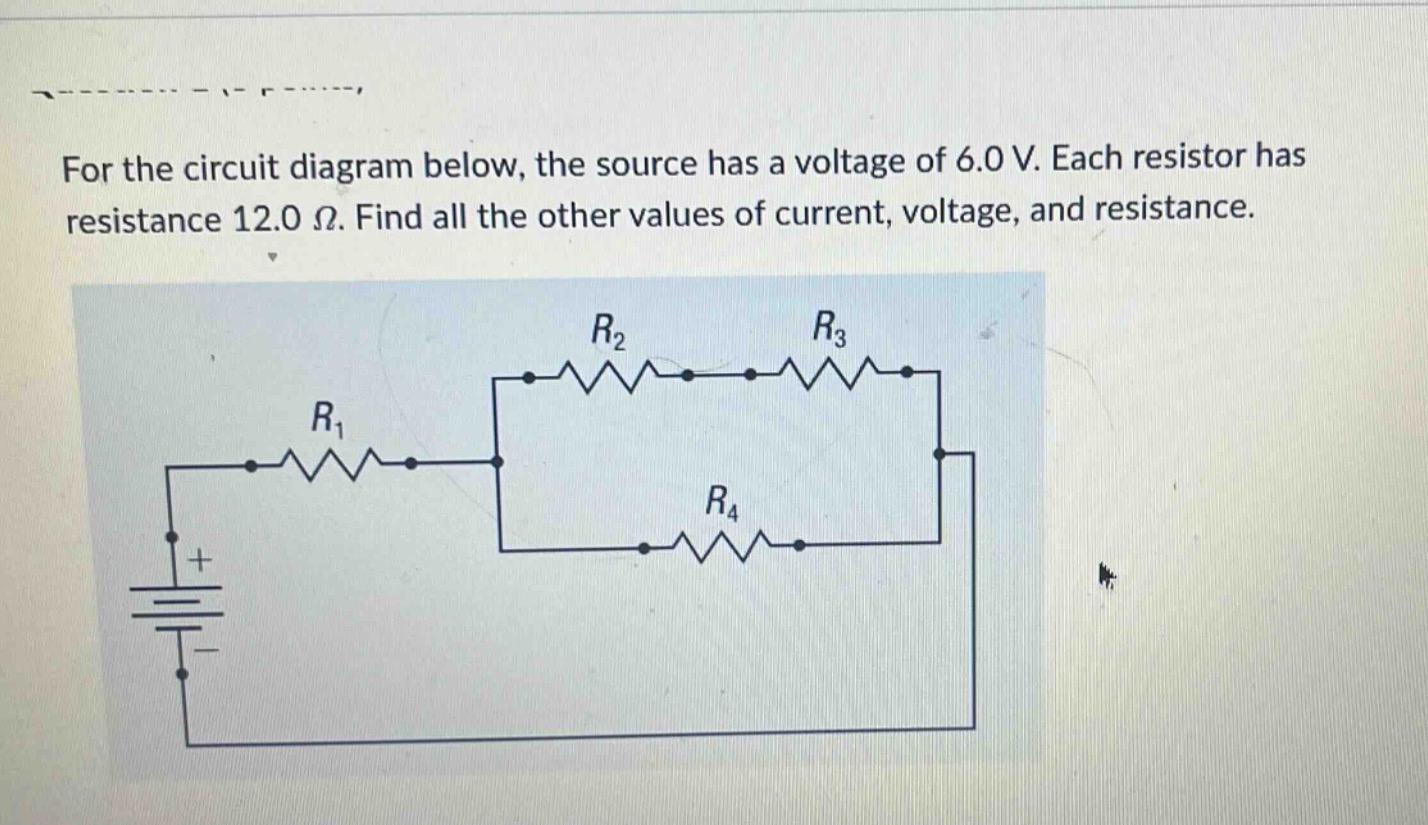
for the circuit diagram below, the source has a voltage of 6.0 v. each resistor has resistance 12.0 ω. find all the other values of current, voltage, and resistance.
Answer
Explanation:
Step1: Calculate equivalent resistance of $R_2$ and $R_3$ in series
$R_{23}=R_2 + R_3=12.0\Omega+ 12.0\Omega = 24.0\Omega$
Step2: Calculate equivalent resistance of $R_{23}$ and $R_4$ in parallel
$R_{eq1}=\frac{R_{23}\times R_4}{R_{23}+R_4}=\frac{24.0\Omega\times12.0\Omega}{24.0\Omega + 12.0\Omega}=8.0\Omega$
Step3: Calculate total equivalent resistance of the circuit
$R_{total}=R_1+R_{eq1}=12.0\Omega + 8.0\Omega=20.0\Omega$
Step4: Calculate total current in the circuit using Ohm's law ($V = IR$)
$I_{total}=\frac{V}{R_{total}}=\frac{6.0V}{20.0\Omega}=0.3A$
Step5: Calculate voltage across $R_1$
$V_1 = I_{total}\times R_1=0.3A\times12.0\Omega = 3.6V$
Step6: Calculate voltage across the parallel - part
$V_{parallel}=V - V_1=6.0V - 3.6V = 2.4V$
Step7: Calculate current through $R_4$
$I_4=\frac{V_{parallel}}{R_4}=\frac{2.4V}{12.0\Omega}=0.2A$
Step8: Calculate current through $R_{23}$
$I_{23}=\frac{V_{parallel}}{R_{23}}=\frac{2.4V}{24.0\Omega}=0.1A$
Step9: Calculate current through $R_2$ and $R_3$ (since they are in series)
$I_2 = I_3=I_{23}=0.1A$
Step10: Calculate voltage across $R_2$
$V_2=I_2\times R_2=0.1A\times12.0\Omega = 1.2V$
Step11: Calculate voltage across $R_3$
$V_3=I_3\times R_3=0.1A\times12.0\Omega = 1.2V$
Answer:
$R_{total}=20.0\Omega$, $I_{total}=0.3A$, $V_1 = 3.6V$, $V_{parallel}=2.4V$, $I_4 = 0.2A$, $I_2=I_3 = 0.1A$, $V_2 = 1.2V$, $V_3 = 1.2V$