a circuit is a path along which electric current flows. how would changing the battery in a circuit from 9…
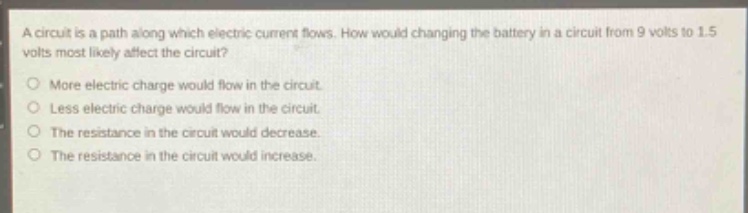
a circuit is a path along which electric current flows. how would changing the battery in a circuit from 9 volts to 1.5 volts most likely affect the circuit?\nmore electric charge would flow in the circuit.\nless electric charge would flow in the circuit.\nthe resistance in the circuit would decrease.\nthe resistance in the circuit would increase.
Answer
Answer:
Less electric charge would flow in the circuit.
Explanation:
Step1: Recall Ohm's Law
$I=\frac{V}{R}$, where $I$ is current, $V$ is voltage, and $R$ is resistance.
Step2: Analyze resistance change
Assume resistance $R$ of the circuit remains constant (since it is mainly determined by the components in the circuit and not directly by the battery voltage change).
Step3: Analyze voltage - current relationship
When voltage $V$ decreases from 9 volts to 1.5 volts (a decrease in $V$), according to $I = \frac{V}{R}$, with $R$ constant, the current $I$ decreases.
Step4: Relate current to charge flow
Current $I=\frac{Q}{t}$, where $Q$ is electric charge and $t$ is time. For a given time $t$, if $I$ decreases, then the amount of electric charge $Q$ that flows in the circuit decreases.