for the circuit shown, determine: (a) (2 marks) the total impedance (in rectangular form); (b) (2 marks) the…
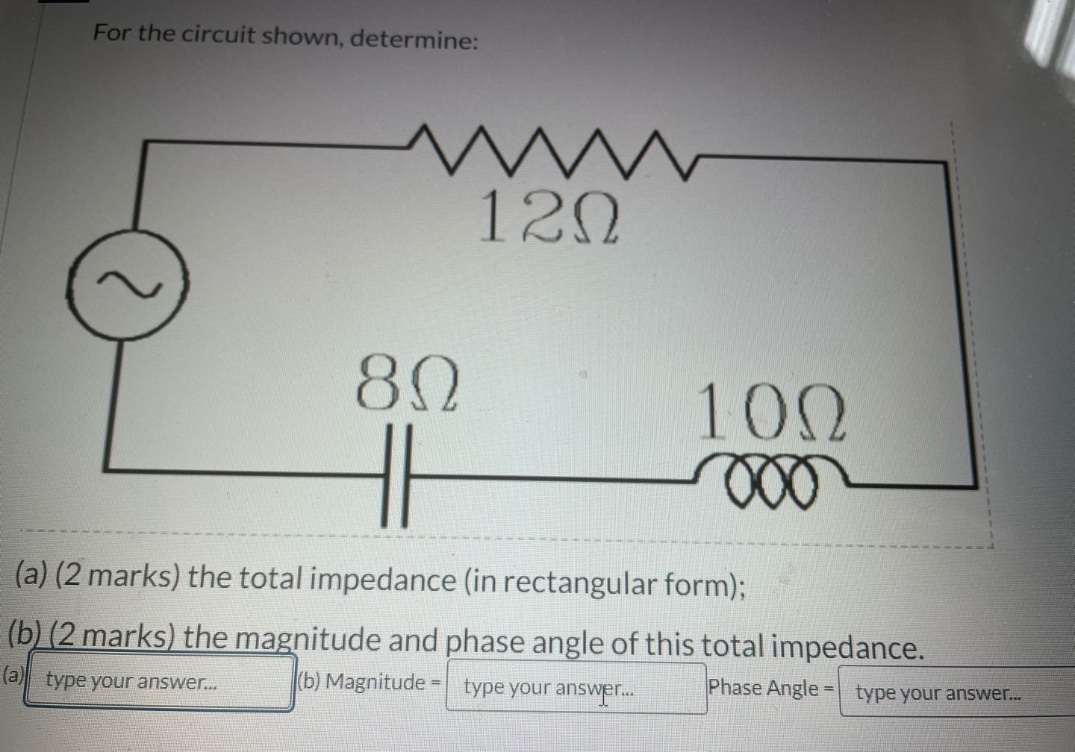
for the circuit shown, determine: (a) (2 marks) the total impedance (in rectangular form); (b) (2 marks) the magnitude and phase angle of this total impedance. (a) type your answer... (b) magnitude = type your answer... phase angle = type your answer...
Answer
Explanation:
Step1: Identify impedance of each component
The resistance $R = 12\Omega$, the capacitive - reactance $X_C=- 8\Omega$ (negative for capacitor), and the inductive - reactance $X_L = 10\Omega$. In an AC - circuit, the impedance of a resistor is $Z_R=R$, the impedance of a capacitor is $Z_C = -jX_C$, and the impedance of an inductor is $Z_L=jX_L$. The total impedance $Z$ of a series - circuit is the sum of the impedances of its components. So, $Z=Z_R + Z_C+Z_L$. $Z = 12 - j8 + j10$
Step2: Simplify the impedance in rectangular form
Combine the imaginary parts: $Z=12 + j(10 - 8)=12 + j2\Omega$
Step3: Calculate the magnitude of the impedance
The magnitude of a complex number $Z=a + jb$ is given by $|Z|=\sqrt{a^{2}+b^{2}}$. Here, $a = 12$ and $b = 2$. So, $|Z|=\sqrt{12^{2}+2^{2}}=\sqrt{144 + 4}=\sqrt{148}=2\sqrt{37}\approx12.1655\Omega$
Step4: Calculate the phase - angle of the impedance
The phase - angle $\theta$ of a complex number $Z=a + jb$ is given by $\theta=\arctan(\frac{b}{a})$. Here, $a = 12$ and $b = 2$. So, $\theta=\arctan(\frac{2}{12})=\arctan(\frac{1}{6})\approx9.46^{\circ}$
Answer:
(a) $12 + j2\Omega$ (b) Magnitude = $2\sqrt{37}\Omega\approx12.17\Omega$ Phase Angle = $\arctan(\frac{1}{6})\approx9.46^{\circ}$