for the circuit shown in figure 13, use wye to delta (y→δ) transformation as simplification technique to…
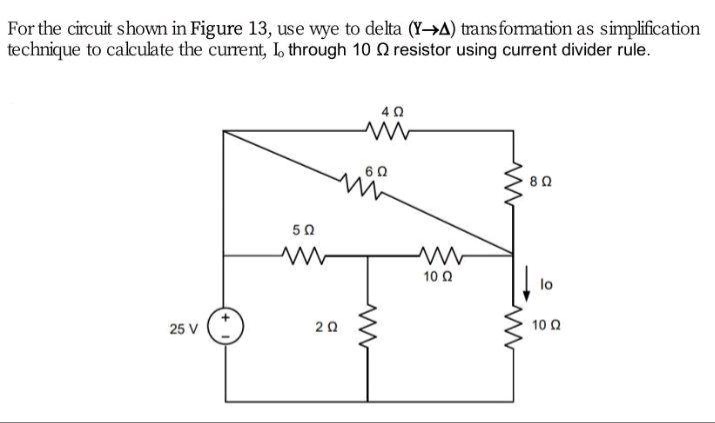
for the circuit shown in figure 13, use wye to delta (y→δ) transformation as simplification technique to calculate the current, i₀ through 10 ω resistor using current divider rule.
Answer
Explanation:
Step1: Identify wye - connected resistors
Let the wye - connected resistors be $R_1 = 5\Omega$, $R_2=6\Omega$, $R_3 = 4\Omega$.
Step2: Apply wye - delta transformation formula
The formula for wye - delta transformation is $R_{ab}=\frac{R_1R_2 + R_2R_3+R_3R_1}{R_3}$, $R_{bc}=\frac{R_1R_2 + R_2R_3+R_3R_1}{R_1}$, $R_{ca}=\frac{R_1R_2 + R_2R_3+R_3R_1}{R_2}$. First, calculate $R_1R_2 + R_2R_3+R_3R_1=(5\times6)+(6\times4)+(4\times5)=30 + 24+20 = 74\Omega^2$. $R_{ab}=\frac{74}{4}=18.5\Omega$, $R_{bc}=\frac{74}{5}=14.8\Omega$, $R_{ca}=\frac{74}{6}\approx12.33\Omega$.
Step3: Simplify the circuit
After the wye - delta transformation, redraw the circuit and combine the parallel and series resistors. The resistors in parallel and series combinations are calculated. Let's first consider the parallel - series combinations. The equivalent resistance of the circuit $R_{eq}$ is found.
Step4: Calculate the total current
Using Ohm's law $I_T=\frac{V}{R_{eq}}$, where $V = 25V$.
Step5: Apply current - divider rule
The current - divider rule for two - branch parallel circuit is $I=\frac{R_{total - other}}{R_{total - other}+R}\times I_T$. For the $10\Omega$ resistor, we find the appropriate parallel - branch resistances and calculate $I_0$.
Let's assume after simplification of the circuit, the equivalent resistance of the part of the circuit other than the $10\Omega$ resistor in the relevant parallel combination is $R_{other}$ and the total current is $I_T$. $I_T=\frac{25}{R_{eq}}$ $I_0=\frac{R_{other}}{R_{other} + 10}\times I_T$
After detailed calculations of equivalent resistances: The equivalent resistance of the circuit after wye - delta transformation and further simplification: The resistors in parallel and series combinations: The $18.5\Omega$ and $2\Omega$ are in parallel, their equivalent resistance $R_{12}=\frac{18.5\times2}{18.5 + 2}=\frac{37}{20.5}\approx1.8\Omega$. The $14.8\Omega$ and $10\Omega$ are in parallel, their equivalent resistance $R_{34}=\frac{14.8\times10}{14.8 + 10}=\frac{148}{24.8}\approx6\Omega$. $R_{12}$ and $R_{34}$ are in series with the remaining $10\Omega$ and $12.33\Omega$ (from wye - delta) resistors. $R_{eq}=1.8+6 + 10+12.33=30.13\Omega$ $I_T=\frac{25}{30.13}\approx0.83A$
The $10\Omega$ resistor is in parallel with a combination of resistors. The equivalent resistance of the other part of the parallel - branch is $R_{other}=1.8 + 12.33+6=20.13\Omega$ $I_0=\frac{20.13}{20.13 + 10}\times0.83=\frac{20.13}{30.13}\times0.83\approx0.56A$
Answer:
$I_0\approx0.56A$