which claim about acceleration is shown to be mathematically supported from the relationship between…
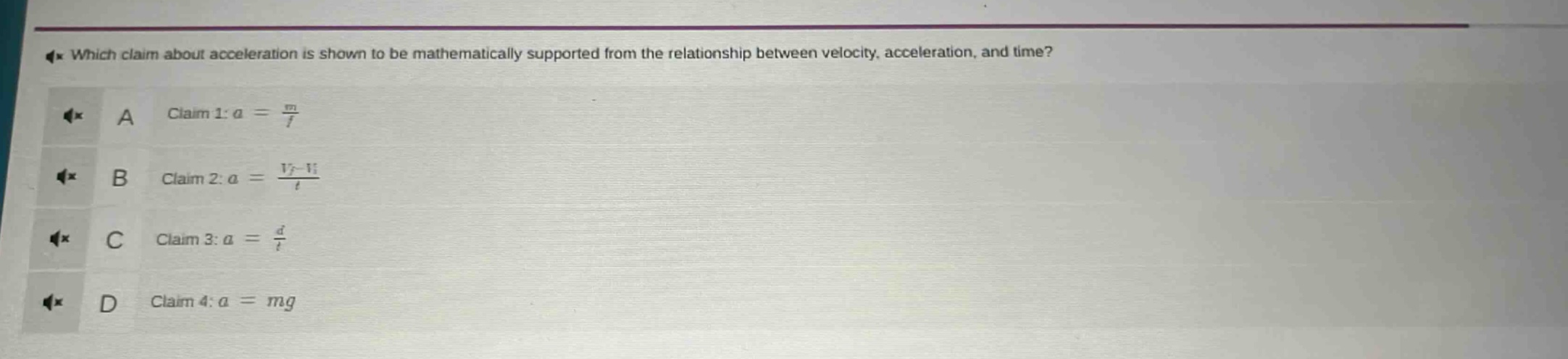
which claim about acceleration is shown to be mathematically supported from the relationship between velocity, acceleration, and time?\na claim 1: $a=\frac{m}{f}$\nb claim 2: $a = \frac{v_f - v_i}{t}$\nc claim 3: $a=\frac{d}{t}$\nd claim 4: $a = mg$
Answer
Explanation:
Step1: Recall acceleration formula
Acceleration $a$ is defined as the change in velocity $\Delta v$ over time $t$. The change in velocity $\Delta v=v_f - v_i$, where $v_f$ is final - velocity and $v_i$ is initial - velocity. So, $a=\frac{v_f - v_i}{t}$.
Step2: Analyze each option
- Option A: $a = \frac{m}{f}$ has no physical meaning related to velocity, acceleration, and time.
- Option B: $a=\frac{v_f - v_i}{t}$ is the correct formula for acceleration in terms of initial and final velocities and time.
- Option C: $a=\frac{d}{t}$ is the formula for average speed (where $d$ is distance), not acceleration.
- Option D: $a = mg$ is not the formula for acceleration in terms of velocity and time. Here, $mg$ is the force due to gravity on an object of mass $m$ (weight), and $a = g$ is the acceleration due to gravity, but this is not related to the velocity - time relationship for general acceleration.
Answer:
B. Claim 2: $a=\frac{v_f - v_i}{t}$