click the blue text to correct the passage about energy transformations during the roller coaster ride. at…
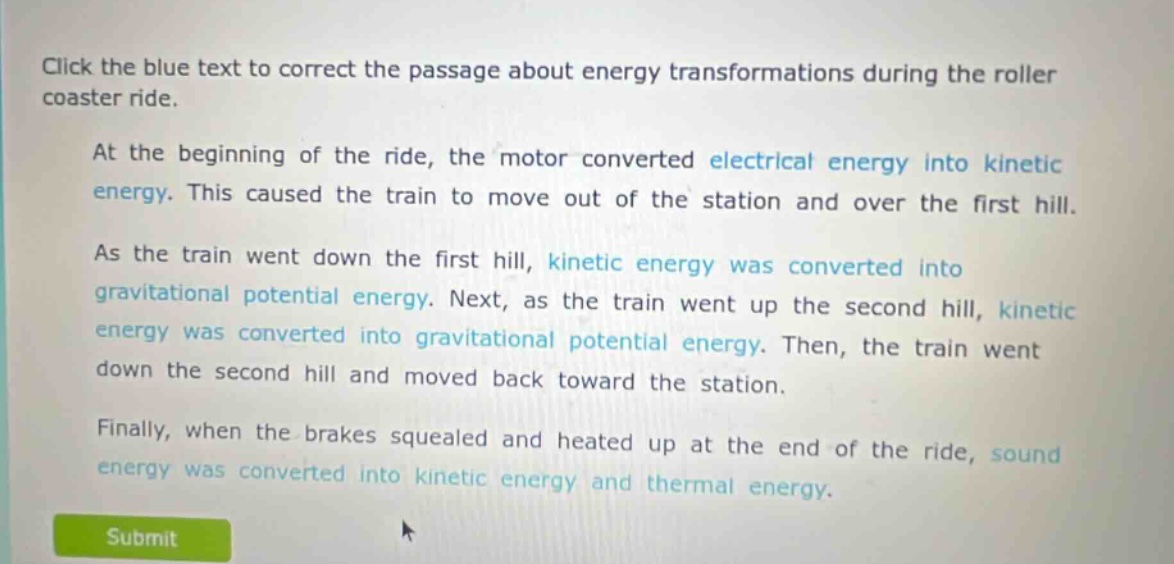
click the blue text to correct the passage about energy transformations during the roller coaster ride. at the beginning of the ride, the motor converted electrical energy into kinetic energy. this caused the train to move out of the station and over the first hill. as the train went down the first hill, kinetic energy was converted into gravitational potential energy. next, as the train went up the second hill, kinetic energy was converted into gravitational potential energy. then, the train went down the second hill and moved back toward the station. finally, when the brakes squealed and heated up at the end of the ride, sound energy was converted into kinetic energy and thermal energy.
Answer
Brief Explanations:
The first statement is correct as the motor uses electrical energy to give the train kinetic energy. When the train goes down the first hill, gravitational - potential energy is converted into kinetic energy, not the other way around. When going up the second hill, kinetic energy is correctly converted into gravitational - potential energy. At the end, when the brakes squeal and heat up, kinetic energy is converted into sound and thermal energy, not the other way around.
Answer:
At the beginning of the ride, the motor converted electrical energy into kinetic energy. This caused the train to move out of the station and over the first hill. As the train went down the first hill, gravitational potential energy was converted into kinetic energy. Next, as the train went up the second hill, kinetic energy was converted into gravitational potential energy. Then, the train went down the second hill and moved back toward the station. Finally, when the brakes squealed and heated up at the end of the ride, kinetic energy was converted into sound energy and thermal energy.