complete combustion of a 0.350 g sample of a compound in a bomb calorimeter releases 14.0 kj of heat. the…
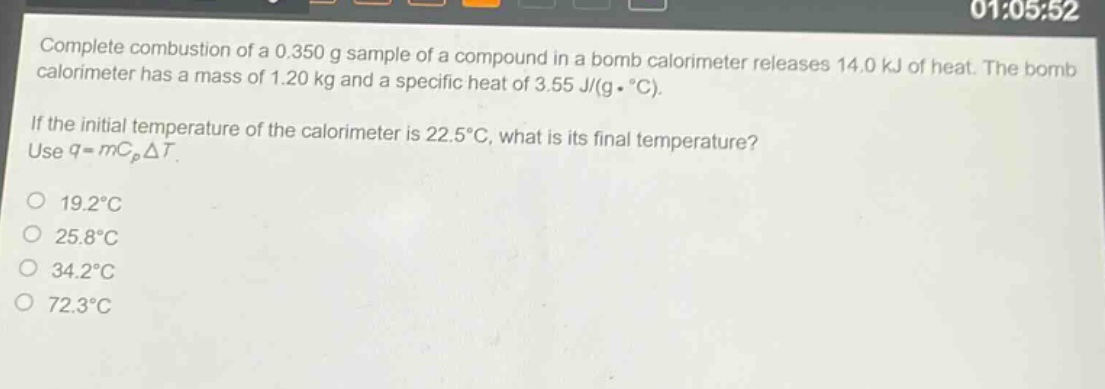
complete combustion of a 0.350 g sample of a compound in a bomb calorimeter releases 14.0 kj of heat. the bomb calorimeter has a mass of 1.20 kg and a specific heat of 3.55 j/(g·°c). if the initial temperature of the calorimeter is 22.5°c, what is its final temperature? use q = mcpδt. 19.2°c 25.8°c 34.2°c 72.3°c
Answer
Answer:
C. $34.2^{\circ}C$
Explanation:
Step1: Convert mass unit
First, convert the mass of the calorimeter from kg to g. Since $1\ kg = 1000\ g$, then $m = 1.20\ kg=1.20\times1000 = 1200\ g$.
Step2: Rearrange the heat - capacity formula
The heat - capacity formula is $q = mC_p\Delta T$, and we want to find $\Delta T$. Rearranging gives $\Delta T=\frac{q}{mC_p}$. Given $q = 14.0\ kJ=14000\ J$, $m = 1200\ g$ and $C_p=3.55\ J/(g\cdot^{\circ}C)$.
Step3: Calculate $\Delta T$
Substitute the values into the formula: $\Delta T=\frac{14000\ J}{1200\ g\times3.55\ J/(g\cdot^{\circ}C)}\approx 3.2^{\circ}C$.
Step4: Calculate the final temperature
The initial temperature $T_i = 22.5^{\circ}C$. The final temperature $T_f=T_i+\Delta T$. So $T_f=22.5^{\circ}C + 3.2^{\circ}C=34.2^{\circ}C$.