complete each nuclear reaction.\n$_{1}^{2}h + _{1}^{2}h \\rightarrow _{e}^{d}he + _{0}^{1}n$\n$_{92}^{238}u…
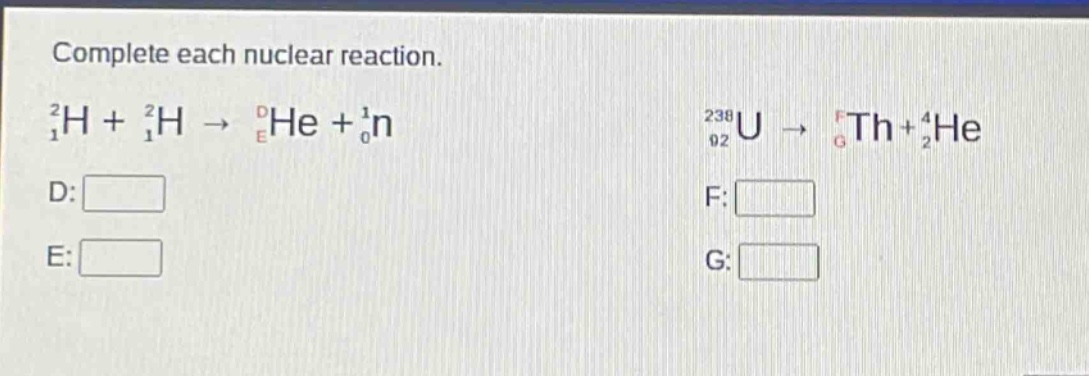
complete each nuclear reaction.\n$_{1}^{2}h + _{1}^{2}h \\rightarrow _{e}^{d}he + _{0}^{1}n$\n$_{92}^{238}u \\rightarrow _{g}^{f}th + _{2}^{4}he$\nd: \ne: \nf: \ng:
Answer
Explanation:
Step1: Apply mass - number conservation for the first reaction
In a nuclear reaction, the sum of mass - numbers on the left - hand side equals the sum of mass - numbers on the right - hand side. For the reaction ${1}^{2}H+{1}^{2}H\rightarrow _{E}^{D}He + _{0}^{1}n$, the sum of mass - numbers on the left is $2 + 2=4$. On the right, the mass - number of the neutron is 1. So, $D=4 - 1=3$.
Step2: Apply atomic - number conservation for the first reaction
The sum of atomic numbers on the left - hand side equals the sum of atomic numbers on the right - hand side. The atomic number of hydrogen is 1, so the sum of atomic numbers on the left is $1+1 = 2$. The atomic number of a neutron is 0. So, $E = 2$.
Step3: Apply mass - number conservation for the second reaction
For the reaction $_{92}^{238}U\rightarrow {G}^{F}Th+{2}^{4}He$, the mass - number of uranium is 238 and the mass - number of helium is 4. So, $F=238 - 4=234$.
Step4: Apply atomic - number conservation for the second reaction
The atomic number of uranium is 92 and the atomic number of helium is 2. So, $G=92 - 2=90$.
Answer:
D: 3 E: 2 F: 234 G: 90