a computer program calculates the amount of kinetic energy (ke) and elastic potential energy (pe) for a ball…
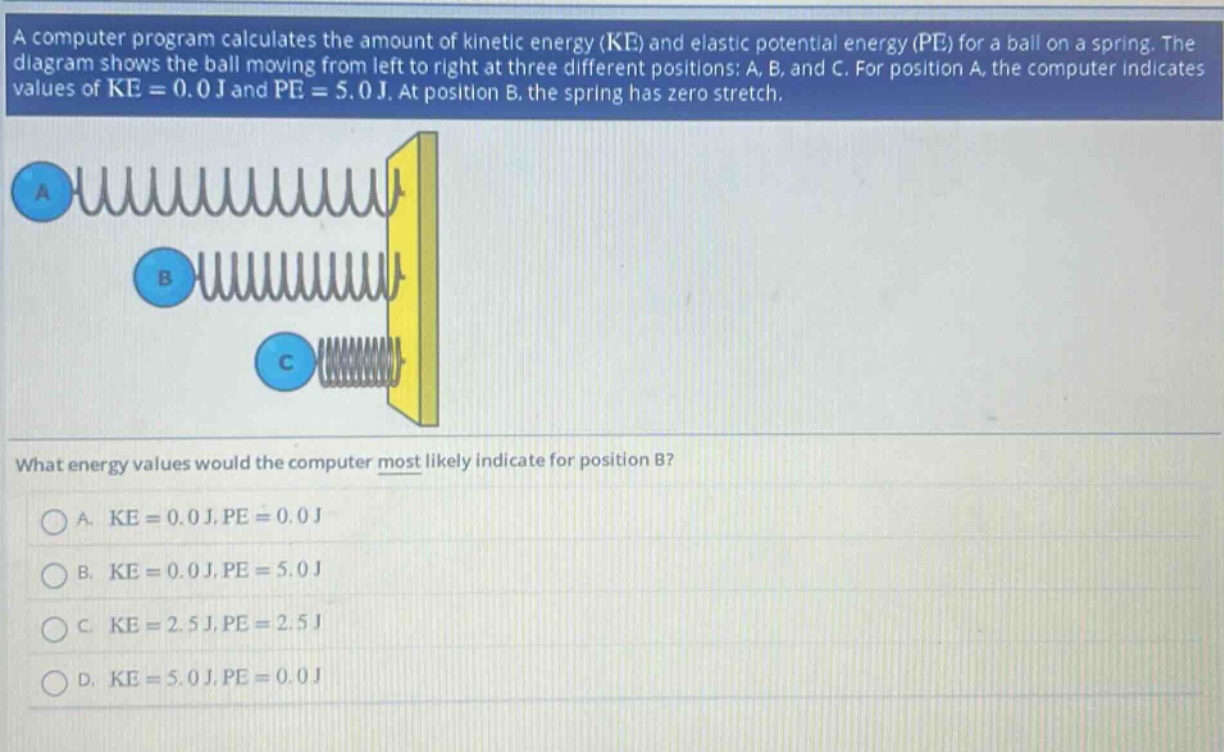
a computer program calculates the amount of kinetic energy (ke) and elastic potential energy (pe) for a ball on a spring. the diagram shows the ball moving from left to right at three different positions: a, b, and c. for position a, the computer indicates values of ke = 0.0 j and pe = 5.0 j. at position b, the spring has zero stretch. what energy values would the computer most likely indicate for position b? a. ke = 0.0 j, pe = 0.0 j b. ke = 0.0 j, pe = 5.0 j c. ke = 2.5 j, pe = 2.5 j d. ke = 5.0 j, pe = 0.0 j
Answer
Explanation:
Step1: Recall energy - conservation principle
The total mechanical energy (E = KE+PE) is conserved in an ideal system (no non - conservative forces like friction). At position A, (E = 0.0\ J+5.0\ J=5.0\ J).
Step2: Analyze position B
At position B, the spring has zero stretch. Elastic potential energy (PE=\frac{1}{2}kx^{2}), where (x = 0) (stretch of the spring), so (PE = 0\ J). Since total energy (E = 5.0\ J) and (E=KE + PE), then (KE=E - PE). Substituting (E = 5.0\ J) and (PE = 0\ J), we get (KE = 5.0\ J).
Answer:
D. (KE = 5.0\ J, PE = 0.0\ J)