what conclusion can be drawn about the heat of fusion of water from the heating curve?\na the potential…
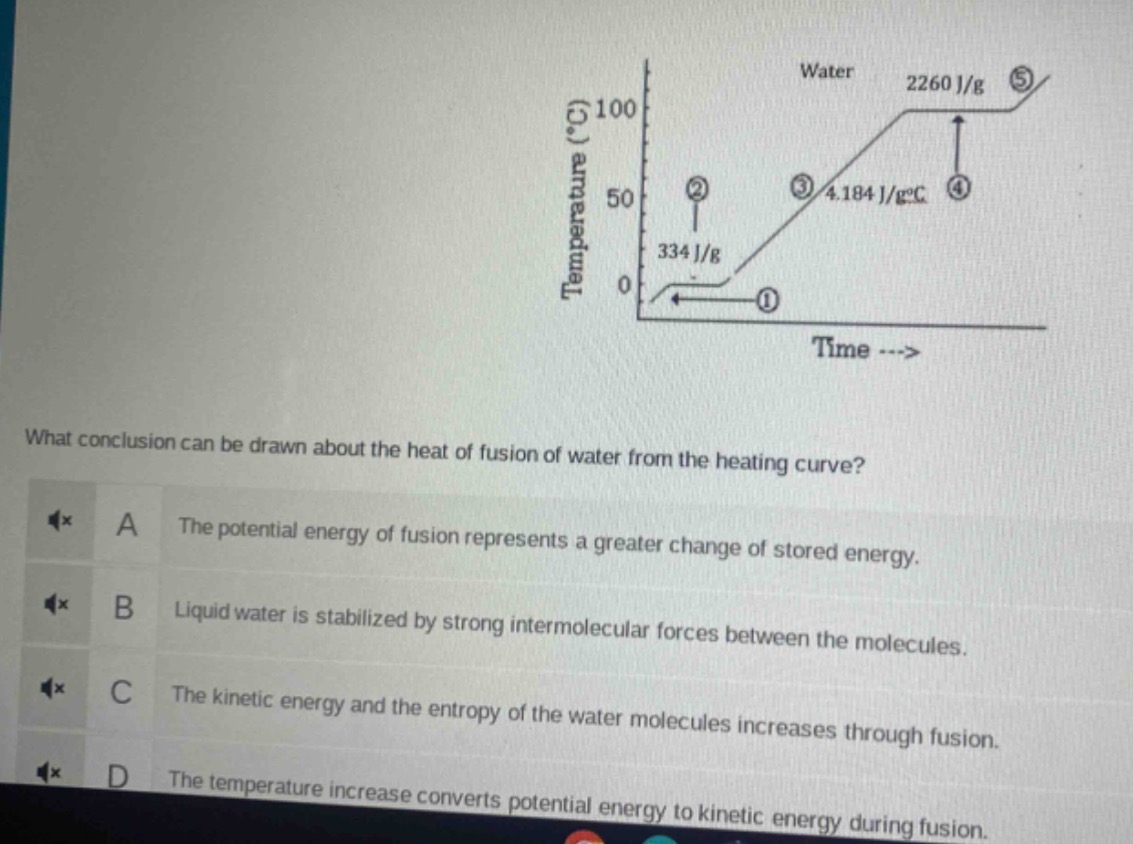
what conclusion can be drawn about the heat of fusion of water from the heating curve?\na the potential energy of fusion represents a greater change of stored energy.\nb liquid water is stabilized by strong intermolecular forces between the molecules.\nc the kinetic energy and the entropy of the water molecules increases through fusion.\nd the temperature increase converts potential energy to kinetic energy during fusion.
Answer
Brief Explanations:
The heat of fusion is the energy required to change a substance from solid to liquid at its melting - point. During the phase - change of ice to water (fusion), the temperature remains constant while heat is being absorbed. This absorbed heat is used to break the intermolecular forces holding the ice together, increasing the potential energy of the system. The heat of fusion of water is 334 J/g as shown on the heating curve. This value indicates that a significant amount of energy is needed to overcome the intermolecular forces in ice to form liquid water, which implies that liquid water is stabilized by strong intermolecular forces between the molecules.
Answer:
B. Liquid water is stabilized by strong intermolecular forces between the molecules.