under which conditions does the molar volume of a gas decrease?\n at 273 k and at 2.0 atm\n at 273 k and at…
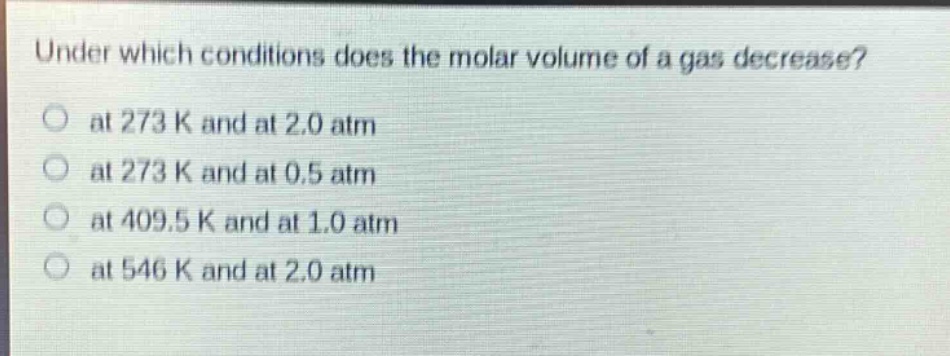
under which conditions does the molar volume of a gas decrease?\n at 273 k and at 2.0 atm\n at 273 k and at 0.5 atm\n at 409.5 k and at 1.0 atm\n at 546 k and at 2.0 atm
Answer
Explanation:
Step1: Recall ideal gas law
The ideal gas law is $PV = nRT$, and molar - volume $V_m=\frac{V}{n}=\frac{RT}{P}$.
Step2: Analyze each option
- Option 1: $T = 273\ K$, $P = 2.0\ atm$, $V_m=\frac{R\times273}{2.0}$.
- Option 2: $T = 273\ K$, $P = 0.5\ atm$, $V_m=\frac{R\times273}{0.5}$.
- Option 3: $T = 409.5\ K$, $P = 1.0\ atm$, $V_m=\frac{R\times409.5}{1.0}$.
- Option 4: $T = 546\ K$, $P = 2.0\ atm$, $V_m=\frac{R\times546}{2.0}$.
Step3: Compare molar - volumes
We know that $R$ is a constant. By comparing the values of $\frac{RT}{P}$ for each option, we can see that for option 1 with $T = 273\ K$ and $P = 2.0\ atm$, the value of $V_m$ is relatively small compared to the others.
Answer:
at 273 K and at 2.0 atm