consider a balloon that has a volume v. it contains n moles of gas, it has an internal pressure of p, and…
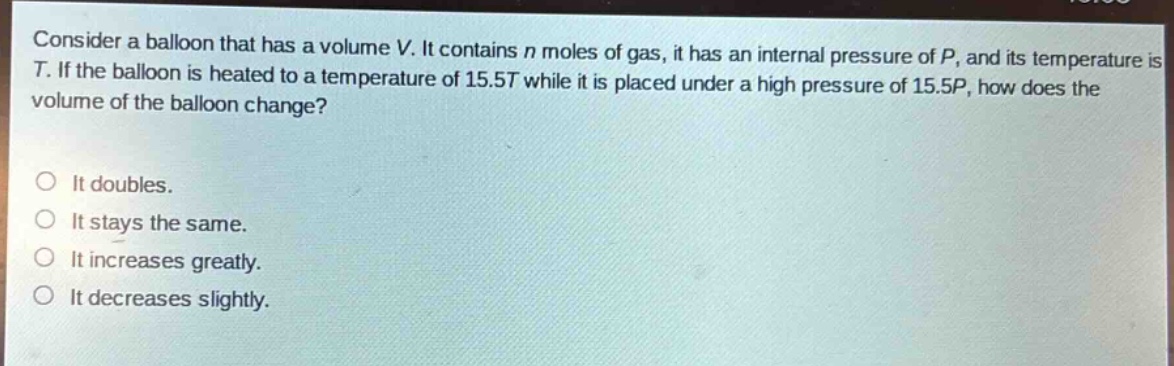
consider a balloon that has a volume v. it contains n moles of gas, it has an internal pressure of p, and its temperature is t. if the balloon is heated to a temperature of 15.5t while it is placed under a high pressure of 15.5p, how does the volume of the balloon change?\n\nit doubles.\nit stays the same.\nit increases greatly.\nit decreases slightly.
Answer
Explanation:
Step1: Recall ideal gas law
The ideal - gas law is $PV = nRT$. Initially, $P_1V_1=nR T_1$. After the change, $P_2V_2=nR T_2$.
Step2: Identify initial and final conditions
We know that $P_1 = P$, $V_1 = V$, $T_1 = T$, $P_2=15.5P$, and $T_2 = 15.5T$.
Step3: Set up the ratio of the two ideal - gas law equations
$\frac{P_1V_1}{T_1}=\frac{P_2V_2}{T_2}$. Substitute the values: $\frac{PV}{T}=\frac{(15.5P)V_2}{15.5T}$.
Step4: Solve for $V_2$
Cross - multiply: $PV\times15.5T=(15.5P)V_2\times T$. Then, cancel out the common factors $15.5$, $P$, and $T$ on both sides. We get $V_2 = V$.
Answer:
It stays the same.