consider a balloon that has a volume v. it contains n moles of gas, it has an internal pressure of p, and…
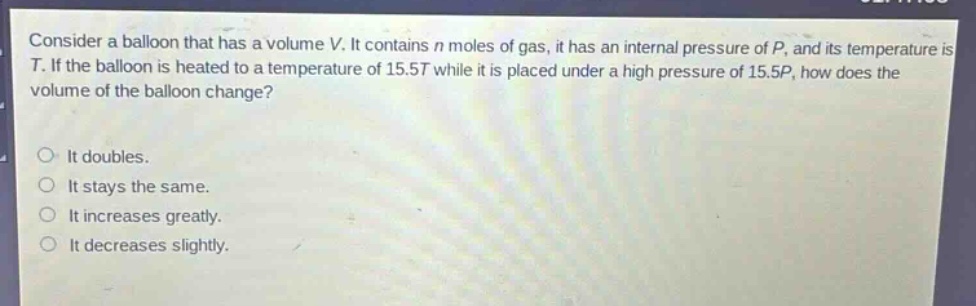
consider a balloon that has a volume v. it contains n moles of gas, it has an internal pressure of p, and its temperature is t. if the balloon is heated to a temperature of 15.5t while it is placed under a high pressure of 15.5p, how does the volume of the balloon change?\nit doubles.\nit stays the same.\nit increases greatly.\nit decreases slightly.
Answer
Explanation:
Step1: Recall ideal gas law
The ideal - gas law is $PV = nRT$, where $P$ is pressure, $V$ is volume, $n$ is the number of moles, $R$ is the ideal - gas constant, and $T$ is temperature. Initially, $P_1V_1=nRT_1$. After the change, $P_2V_2=nRT_2$.
Step2: Substitute given values
We know that $P_2 = 15.5P_1$, $T_2=15.5T_1$. Substituting into the ideal - gas law $P_2V_2=nRT_2$ gives $(15.5P_1)V_2=nR(15.5T_1)$.
Step3: Compare with initial state
From the initial state $P_1V_1=nRT_1$, and from the new - state equation $(15.5P_1)V_2=nR(15.5T_1)$. We can rewrite the new - state equation as $15.5P_1V_2 = 15.5nRT_1$. Dividing both sides by $15.5P_1$ gives $V_2=\frac{nRT_1}{P_1}$. Since $P_1V_1=nRT_1$, then $V_2 = V_1$.
Answer:
It stays the same.