consider the nuclear equation below.\nx $longrightarrow$ $_{89}^{228}$ac + $_{-1}^{0}$β\nwhat is the nuclide…
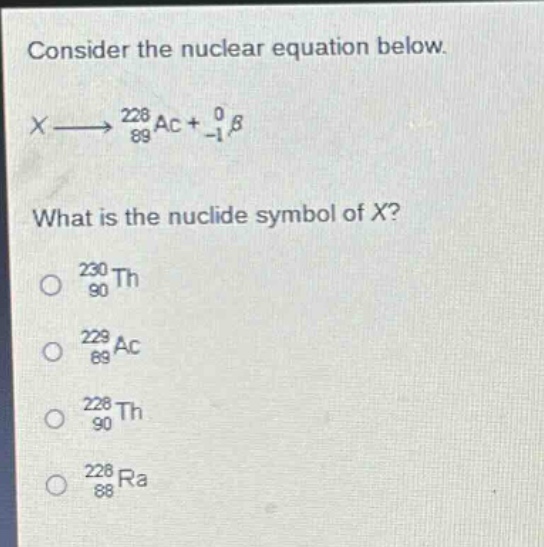
consider the nuclear equation below.\nx $longrightarrow$ $_{89}^{228}$ac + $_{-1}^{0}$β\nwhat is the nuclide symbol of x?\n$_{90}^{230}$th\n$_{89}^{229}$ac\n$_{90}^{228}$th\n$_{88}^{228}$ra
Answer
Explanation:
Step1: Apply mass - number conservation
In a nuclear reaction, the sum of mass - numbers on the left - hand side equals the sum of mass - numbers on the right - hand side. The mass - number of $^{228}{89}Ac$ is 228 and the mass - number of $^{\ 0}{- 1}\beta$ is 0. Let the mass - number of $X$ be $A$. Then $A=228 + 0=228$.
Step2: Apply atomic - number conservation
The sum of atomic numbers on the left - hand side equals the sum of atomic numbers on the right - hand side. The atomic number of $^{228}{89}Ac$ is 89 and the atomic number of $^{\ 0}{- 1}\beta$ is - 1. Let the atomic number of $X$ be $Z$. Then $Z=89+( - 1)=88$.
Step3: Identify the element
The element with atomic number $Z = 88$ is radium, $Ra$.
Answer:
$^{228}_{88}Ra$