consider the same two pure samples of gas. the particles in sample b have a lower average kinetic energy…
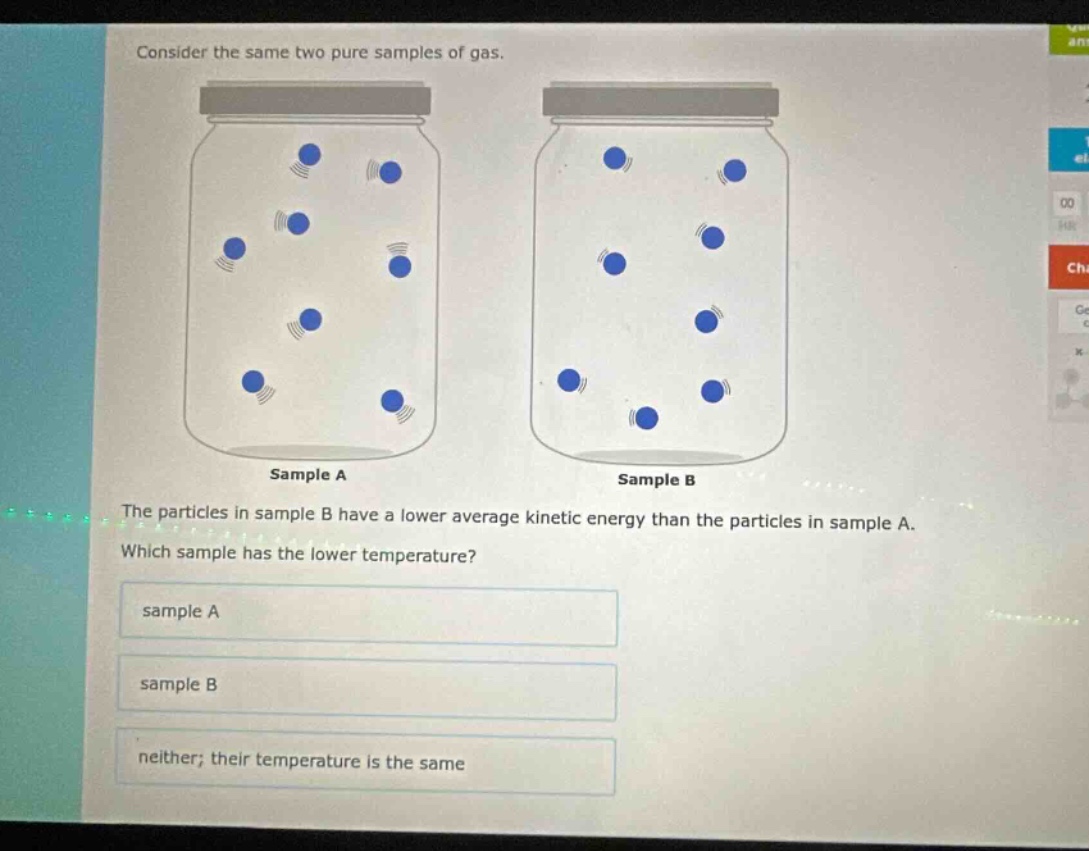
consider the same two pure samples of gas. the particles in sample b have a lower average kinetic energy than the particles in sample a. which sample has the lower temperature? sample a sample b neither; their temperature is the same
Answer
Explanation:
Step1: Recall kinetic - energy and temperature relation
The average kinetic energy of gas particles is directly proportional to the temperature of the gas. Mathematically, $\overline{K.E.}=\frac{3}{2}kT$, where $\overline{K.E.}$ is the average kinetic energy of the particles, $k$ is the Boltzmann constant, and $T$ is the temperature.
Step2: Compare kinetic energies and temperatures
Since the particles in sample B have a lower average kinetic energy than the particles in sample A, and average kinetic energy is directly proportional to temperature, sample B has a lower temperature.
Answer:
sample B