for a constant voltage, how is the resistance related to the current?\nresistance is inversely proportional…
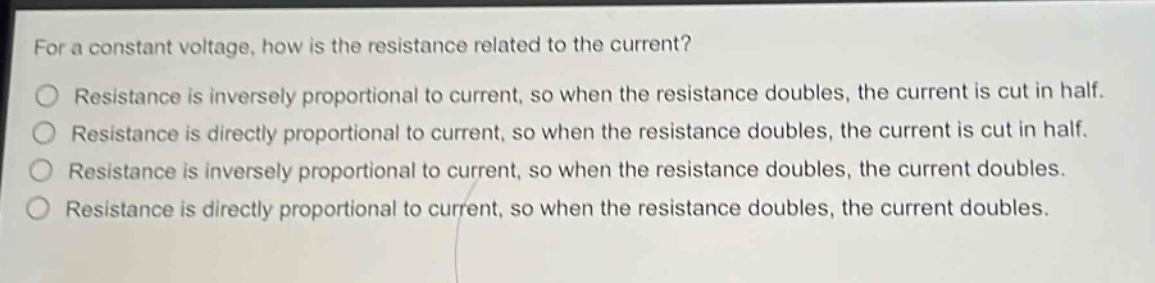
for a constant voltage, how is the resistance related to the current?\nresistance is inversely proportional to current, so when the resistance doubles, the current is cut in half.\nresistance is directly proportional to current, so when the resistance doubles, the current is cut in half.\nresistance is inversely proportional to current, so when the resistance doubles, the current doubles.\nresistance is directly proportional to current, so when the resistance doubles, the current doubles.
Answer
Brief Explanations:
According to Ohm's law $V = IR$ (where $V$ is voltage, $I$ is current, and $R$ is resistance). When $V$ is constant, $I=\frac{V}{R}$, which shows an inverse - proportional relationship. If $R$ doubles, $I$ will be halved since $I$ is inversely proportional to $R$.
Answer:
Resistance is inversely proportional to current, so when the resistance doubles, the current is cut in half.