container\tproperties\n1\tlow number of collisions with container walls\n\tmedium average kinetic…
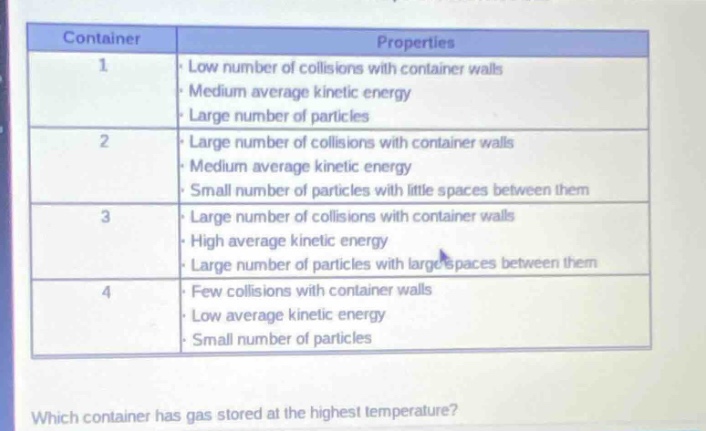
container\tproperties\n1\tlow number of collisions with container walls\n\tmedium average kinetic energy\n\tlarge number of particles\n2\tlarge number of collisions with container walls\n\tmedium average kinetic energy\n\tsmall number of particles with little spaces between them\n3\tlarge number of collisions with container walls\n\thigh average kinetic energy\n\tlarge number of particles with large spaces between them\n4\tfew collisions with container walls\n\tlow average kinetic energy\n\tsmall number of particles\nwhich container has gas stored at the highest temperature?
Answer
Answer:
3
Explanation:
Step1: Recall temperature - kinetic energy relation
Temperature is directly related to average kinetic energy of gas particles. Higher average kinetic energy means higher temperature.
Step2: Analyze each container
Container 1 has medium average kinetic energy. Container 2 has medium average kinetic energy. Container 3 has high average kinetic energy. Container 4 has low average kinetic energy.
Step3: Determine the answer
Since Container 3 has the highest average kinetic energy among the four containers, it has gas stored at the highest temperature.