7. in a crash - test, a car of mass (1.50\times10^{3}\text{ kg}) collides with a wall and rebounds as in the…
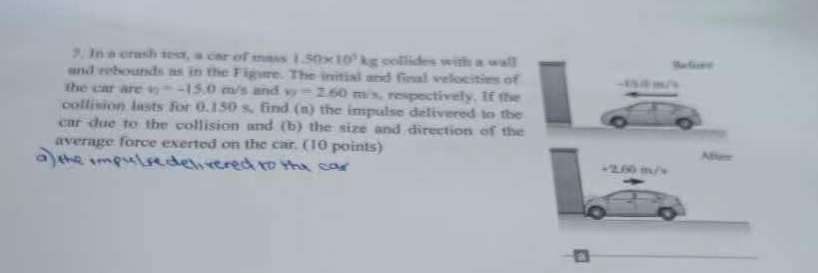
7. in a crash - test, a car of mass (1.50\times10^{3}\text{ kg}) collides with a wall and rebounds as in the figure. the initial and final velocities of the car are (v_{i}=-15.0\text{ m/s}) and (v_{f}=2.60\text{ m/s}), respectively. if the collision lasts for (0.150\text{ s}), find (a) the impulse delivered to the car due to the collision and (b) the size and direction of the average force exerted on the car. (10 points)\na) the impulse delivered to the car
Answer
Explanation:
Step1: Recall impulse - momentum theorem
Impulse $J$ is equal to the change in momentum $\Delta p$. The formula for momentum is $p = mv$. So, $J=\Delta p = m(v_f - v_i)$. Given $m = 1.50\times10^{3}\text{ kg}$, $v_i=- 15.0\text{ m/s}$ and $v_f = 2.60\text{ m/s}$.
Step2: Calculate the impulse
Substitute the values into the formula: [ \begin{align*} J&=m(v_f - v_i)\ &=(1.50\times 10^{3}\text{ kg})(2.60\text{ m/s}-(-15.0\text{ m/s}))\ &=(1.50\times 10^{3}\text{ kg})(2.60\text{ m/s}+ 15.0\text{ m/s})\ &=(1.50\times 10^{3}\text{ kg})(17.6\text{ m/s})\ &=2.64\times 10^{4}\text{ kg}\cdot\text{m/s} \end{align*} ]
Step3: Recall the formula for average force
The average force $F_{avg}$ is related to impulse by $J = F_{avg}\Delta t$. We know $J = 2.64\times 10^{4}\text{ kg}\cdot\text{m/s}$ and $\Delta t=0.150\text{ s}$.
Step4: Calculate the average force
[ \begin{align*} F_{avg}&=\frac{J}{\Delta t}\ &=\frac{2.64\times 10^{4}\text{ kg}\cdot\text{m/s}}{0.150\text{ s}}\ &=1.76\times 10^{5}\text{ N} \end{align*} ] The direction of the impulse and the average force is the same as the direction of the final - velocity (since the impulse and force are in the direction of the change in momentum), which is positive (to the right).
Answer:
a) The impulse delivered to the car is $2.64\times 10^{4}\text{ kg}\cdot\text{m/s}$. b) The size of the average force exerted on the car is $1.76\times 10^{5}\text{ N}$ and the direction is to the right.