current flowing in a circuit depends on two variables. identify these variables and their relationship to…
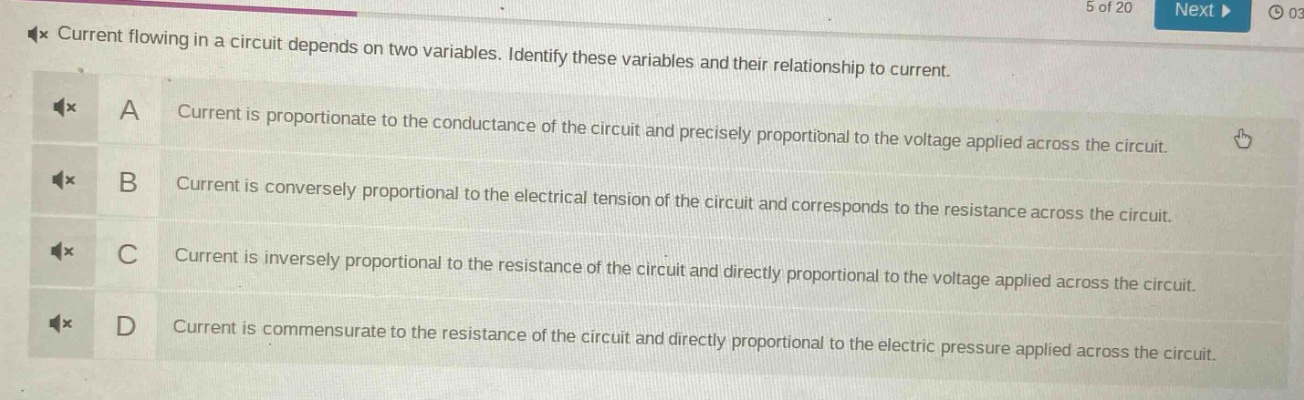
current flowing in a circuit depends on two variables. identify these variables and their relationship to current.\na current is proportionate to the conductance of the circuit and precisely proportional to the voltage applied across the circuit.\nb current is conversely proportional to the electrical tension of the circuit and corresponds to the resistance across the circuit.\nc current is inversely proportional to the resistance of the circuit and directly proportional to the voltage applied across the circuit.\nd current is commensurate to the resistance of the circuit and directly proportional to the electric pressure applied across the circuit.
Answer
Answer:
C. Current is inversely proportional to the resistance of the circuit and directly proportional to the voltage applied across the circuit.
Explanation:
Step1: Recall Ohm's Law
Ohm's Law is $I=\frac{V}{R}$, where $I$ is current, $V$ is voltage, and $R$ is resistance.
Step2: Analyze the relationship
From $I = \frac{V}{R}$, when $V$ increases, $I$ increases (direct - proportion). When $R$ increases, $I$ decreases (inverse - proportion). So current is inversely proportional to resistance and directly proportional to voltage.