the current in the wires of a circuit is 60.0 milliamps. if the voltage impressed across the ends of the…
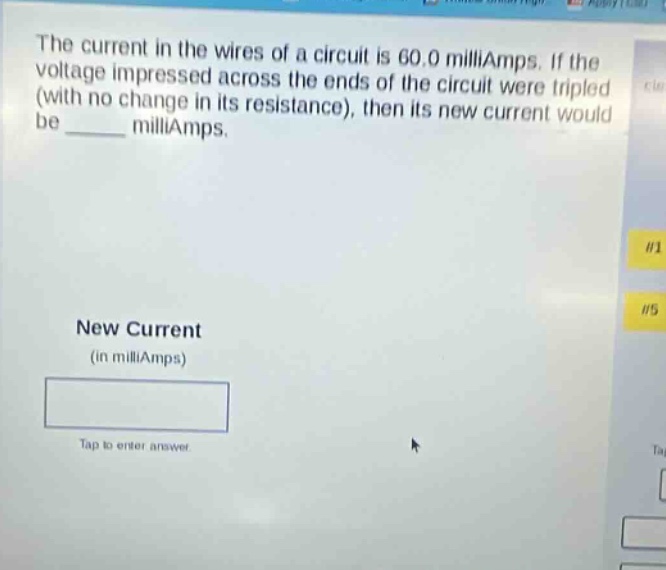
the current in the wires of a circuit is 60.0 milliamps. if the voltage impressed across the ends of the circuit were tripled (with no change in its resistance), then its new current would be ______ milliamps. new current (in milliamps)
Answer
Explanation:
Step1: Recall Ohm's Law
Ohm's Law is (I = \frac{V}{R}), where (I) is current, (V) is voltage, and (R) is resistance. Initially, (I_1=\frac{V_1}{R}), and (I_1 = 60.0\space mA).
Step2: Analyze the new - voltage case
When the voltage is tripled ((V_2 = 3V_1)) and (R) remains constant ((R_2=R_1 = R)), using Ohm's Law (I_2=\frac{V_2}{R}). Substitute (V_2 = 3V_1) into the formula, we get (I_2=\frac{3V_1}{R}).
Step3: Express (I_2) in terms of (I_1)
Since (I_1=\frac{V_1}{R}), then (I_2 = 3\times\frac{V_1}{R}). So (I_2=3I_1)
Step4: Calculate the new current
Substitute (I_1 = 60.0\space mA) into (I_2 = 3I_1). Then (I_2=3\times60.0\space mA)
Answer:
(180)