a cyclist going downhill is accelerating at 1.2 m/s². if the final velocity of the cyclist is 16 m/s after…
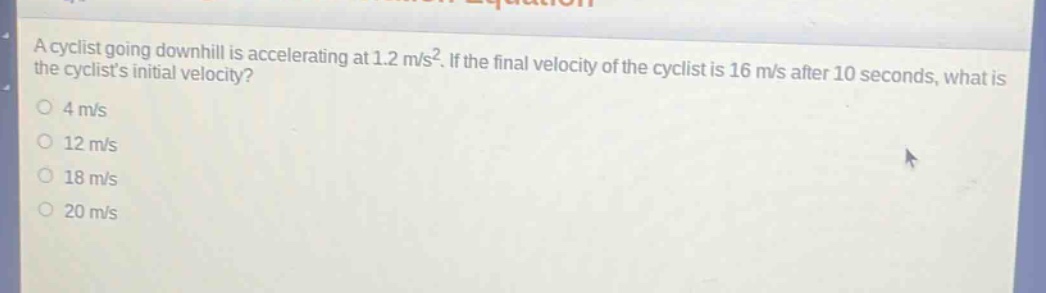
a cyclist going downhill is accelerating at 1.2 m/s². if the final velocity of the cyclist is 16 m/s after 10 seconds, what is the cyclists initial velocity?\n4 m/s\n12 m/s\n18 m/s\n20 m/s
Answer
Explanation:
Step1: Recall the velocity - time formula
The formula is $v = u+at$, where $v$ is final velocity, $u$ is initial velocity, $a$ is acceleration and $t$ is time. We need to solve for $u$, so we can re - arrange the formula to $u=v - at$.
Step2: Substitute the given values
Given $v = 16\ m/s$, $a = 1.2\ m/s^{2}$ and $t = 10\ s$. Substitute into $u=v - at$: $u=16-1.2\times10$.
Step3: Calculate the value of $u$
First, calculate $1.2\times10 = 12$. Then $u=16 - 12$. $u = 4\ m/s$.
Answer:
A. 4 m/s