daniel observed and compared some stars at night and recorded his observations in a chart. which conclusion…
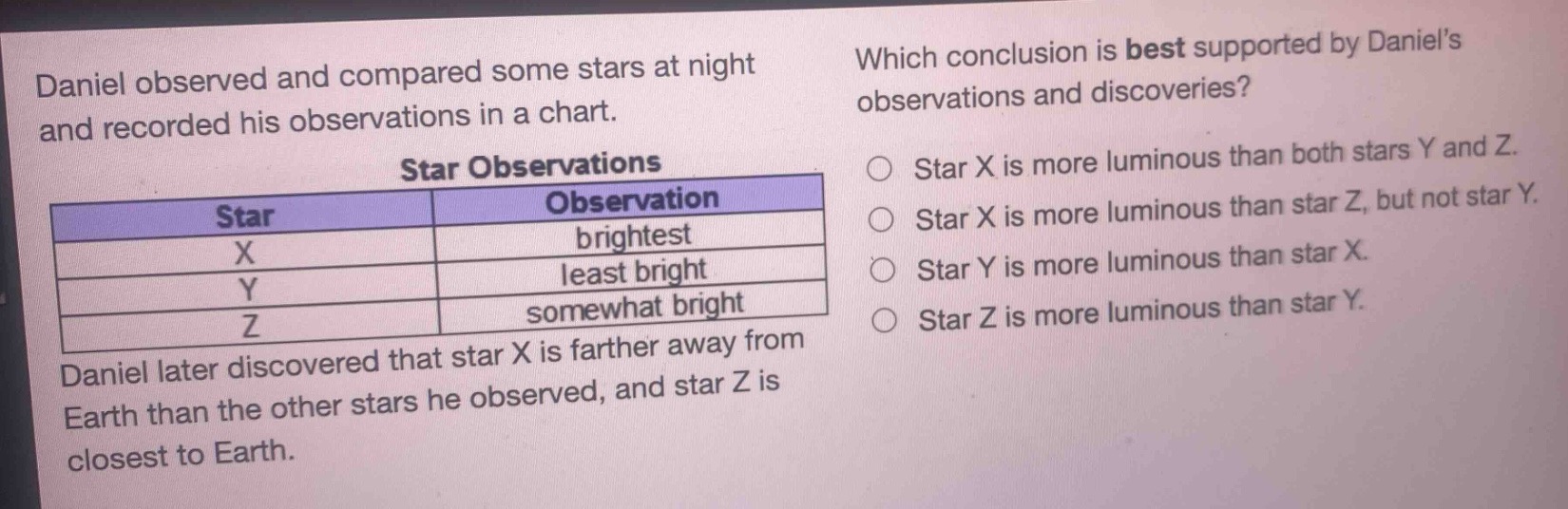
daniel observed and compared some stars at night and recorded his observations in a chart. which conclusion is best supported by daniels observations and discoveries? star observations star observation x brightest y least bright z somewhat bright daniel later discovered that star x is farther away from earth than the other stars he observed, and star z is closest to earth. star x is more luminous than both stars y and z. star x is more luminous than star z, but not star y. star y is more luminous than star x. star z is more luminous than star y.
Answer
Answer:
Star X is more luminous than both stars Y and Z.
Explanation:
Step1: Understand luminosity concept
Luminosity is intrinsic brightness.
Step2: Analyze star brightness
Star X is brightest, Y is least - bright, Z is somewhat bright.
Step3: Consider distance factor
Even though X is farther and Z is closest, X is still brightest, meaning X has higher luminosity than Y and Z.