decide how the sketches below would be listed, if they were listed in order of decreasing force between the…
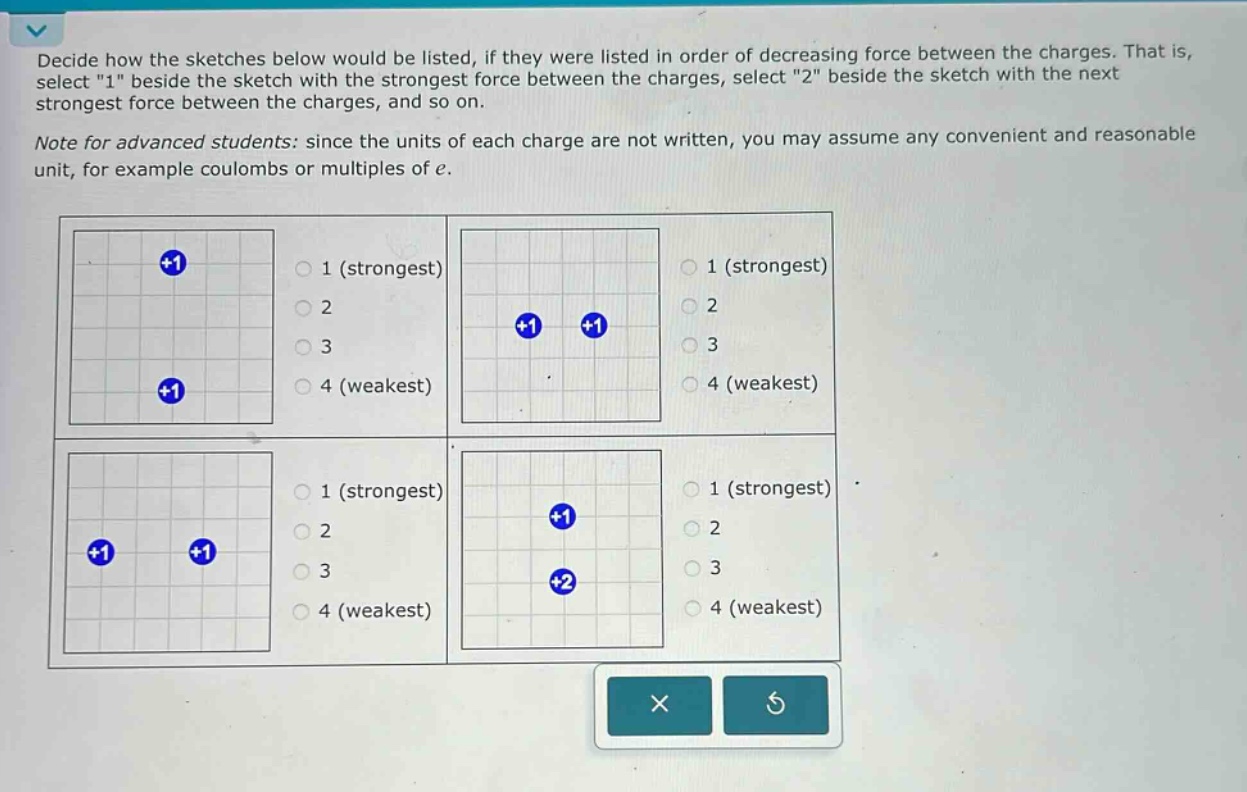
decide how the sketches below would be listed, if they were listed in order of decreasing force between the charges. that is, select \1\ beside the sketch with the strongest force between the charges, select \2\ beside the sketch with the next strongest force between the charges, and so on. note for advanced students: since the units of each charge are not written, you may assume any convenient and reasonable unit, for example coulombs or multiples of e.
Answer
Explanation:
Step1: Recall Coulomb's law
The force between two charges $F = k\frac{q_1q_2}{r^2}$, where $k$ is Coulomb's constant, $q_1$ and $q_2$ are the magnitudes of the charges, and $r$ is the distance between them.
Step2: Analyze the first - type of sketches
For the sketches with charges of magnitude $+ 1$ and $+1$: The force is inversely proportional to the square of the distance between the charges. The closer the charges, the stronger the force.
Step3: Compare the distances
Let's assume the side - length of each small square in the grid is $d$.
- In the first sketch (top - left), if we assume the distance between the two $+1$ charges is $r_1 = 3d$.
- In the second sketch (top - right), the distance between the two $+1$ charges is $r_2=d\sqrt{(1)^2+(1)^2}=\sqrt{2}d$.
- In the third sketch (bottom - left), the distance between the two $+1$ charges is $r_3 = 2d$.
- In the fourth sketch (bottom - right), using Coulomb's law with $q_1 = 1$ and $q_2 = 2$, and assume the distance $r_4=\sqrt{(1)^2+(1)^2}=\sqrt{2}d$. The force $F_4=k\frac{1\times2}{(\sqrt{2}d)^2}=k\frac{2}{2d^2}=k\frac{1}{d^2}$. For the first three sketches with $q_1 = q_2=1$:
- $F_1 = k\frac{1\times1}{(3d)^2}=k\frac{1}{9d^2}$
- $F_2=k\frac{1\times1}{(\sqrt{2}d)^2}=k\frac{1}{2d^2}$
- $F_3=k\frac{1\times1}{(2d)^2}=k\frac{1}{4d^2}$
Step4: Rank the forces
Comparing the magnitudes of the forces: $F_4>F_2>F_3>F_1$.
Answer:
Bottom - right: 1 (strongest) Top - right: 2 Bottom - left: 3 Top - left: 4 (weakest)