denise is riding her bike and falls to the ground. during the collision, she hits both grass and cement…
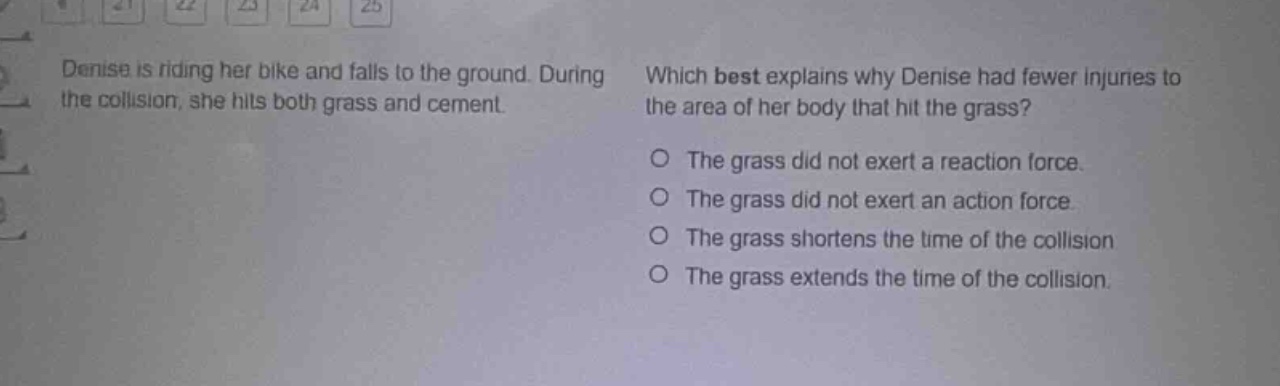
denise is riding her bike and falls to the ground. during the collision, she hits both grass and cement. which best explains why denise had fewer injuries to the area of her body that hit the grass? o the grass did not exert a reaction force. o the grass did not exert an action force. o the grass shortens the time of the collision. o the grass extends the time of the collision.
Answer
Brief Explanations:
According to the impulse - momentum theorem $J = F\Delta t=\Delta p$. When Denise falls, her change in momentum $\Delta p$ is fixed. Grass is more yielding than cement. When hitting the grass, the time of collision $\Delta t$ is extended. Since $\Delta p$ is constant, a longer $\Delta t$ results in a smaller average force $F$ acting on her body, leading to fewer injuries.
Answer:
The grass extends the time of the collision.