describe the habitability of planets\nwhich statement accurately describes the habitability of the…
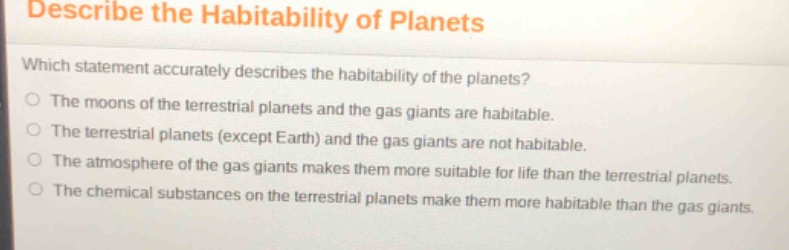
describe the habitability of planets\nwhich statement accurately describes the habitability of the planets?\nthe moons of the terrestrial planets and the gas giants are habitable.\nthe terrestrial planets (except earth) and the gas giants are not habitable.\nthe atmosphere of the gas giants makes them more suitable for life than the terrestrial planets.\nthe chemical substances on the terrestrial planets make them more habitable than the gas giants.
Answer
Answer:
B. The terrestrial planets (except Earth) and the gas giants are not habitable.
Brief Explanations:
- Option A: Moons of terrestrial planets (e.g., Luna - Moon of Earth) and gas giants (e.g., Ganymede - moon of Jupiter) may have some potential for life - like conditions in some cases (e.g., subsurface oceans in some moons), but it is an over - generalization to say they are all habitable.
- Option B: Terrestrial planets other than Earth (Mercury - too hot and no atmosphere, Venus - extremely hot and toxic atmosphere, Mars - thin atmosphere and harsh cold environment) and gas giants (composed mainly of hydrogen and helium with no solid surface in the traditional sense and extreme pressure and temperature conditions) are generally not habitable.
- Option C: Gas giants have thick atmospheres composed mainly of hydrogen and helium with extreme weather (e.g., Jupiter's Great Red Spot - a huge storm). They lack a solid surface and have conditions that are not conducive to life as we know it compared to terrestrial planets (where at least Earth has a solid surface, liquid water, and a breathable atmosphere).
- Option D: While terrestrial planets have a variety of chemical substances, it is not just the presence of chemical substances that makes a planet habitable. Factors like temperature, atmosphere composition, presence of liquid water (in a stable state) are crucial. And gas giants lack many of these key habitable - planet requirements.