which describes an objects speed when free - falling in a vacuum?\nthe object accelerates until it reaches…
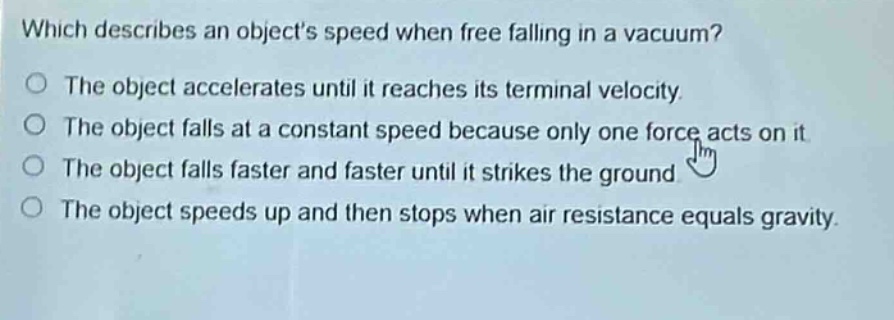
which describes an objects speed when free - falling in a vacuum?\nthe object accelerates until it reaches its terminal velocity.\nthe object falls at a constant speed because only one force acts on it.\nthe object falls faster and faster until it strikes the ground.\nthe object speeds up and then stops when air resistance equals gravity.
Answer
Brief Explanations:
In a vacuum, there is no air - resistance. According to Newton's second law, the only force acting on a free - falling object is gravity. This causes a constant acceleration (acceleration due to gravity, (g\approx9.8\ m/s^{2}) near the Earth's surface). So the object's speed increases as it falls until it strikes the ground. Terminal velocity occurs when air resistance balances gravity, which doesn't happen in a vacuum. Also, the object doesn't fall at a constant speed as there is an unbalanced force (gravity) acting on it.
Answer:
The object falls faster and faster until it strikes the ground.