determine the acceleration of the system and the time it takes the heavier mass to reach the table\nenter…
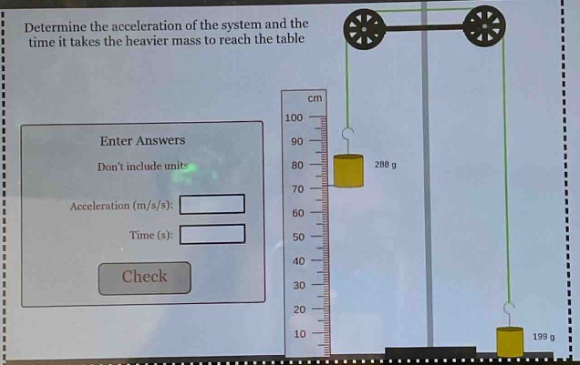
determine the acceleration of the system and the time it takes the heavier mass to reach the table\nenter answers\ndont include units\nacceleration (m/s/s):\ntime (s):\ncheck
Answer
Explanation:
Step1: Set up force - equations
Let $m_1 = 288\ g=0.288\ kg$ and $m_2 = 199\ g = 0.199\ kg$. For the heavier mass $m_1$, $m_1g - T=m_1a$. For the lighter mass $m_2$, $T - m_2g=m_2a$. Adding these two equations gives $(m_1 - m_2)g=(m_1 + m_2)a$. So, $a=\frac{(m_1 - m_2)g}{m_1 + m_2}$, where $g = 9.8\ m/s^2$.
Step2: Calculate the acceleration
Substitute $m_1 = 0.288\ kg$ and $m_2 = 0.199\ kg$ into the acceleration formula: [ \begin{align*} a&=\frac{(0.288 - 0.199)\times9.8}{0.288+ 0.199}\ &=\frac{0.089\times9.8}{0.487}\ &=\frac{0.8722}{0.487}\ &\approx1.8\ m/s^2 \end{align*} ]
Step3: Calculate the time
The heavier mass $m_1$ is initially at a height $h = 90 - 10=80\ cm = 0.8\ m$. Using the kinematic - equation $h=v_0t+\frac{1}{2}at^2$. Since $v_0 = 0$, we have $h=\frac{1}{2}at^2$. Then $t=\sqrt{\frac{2h}{a}}$.
Step4: Substitute values to find time
Substitute $h = 0.8\ m$ and $a\approx1.8\ m/s^2$ into the time formula: [ \begin{align*} t&=\sqrt{\frac{2\times0.8}{1.8}}\ &=\sqrt{\frac{1.6}{1.8}}\ &=\sqrt{\frac{8}{9}}\ &\approx0.94\ s \end{align*} ]
Answer:
Acceleration: 1.8 Time: 0.94