*6 - 8. determine the force in each member of the truss and state if the members are in tension or…
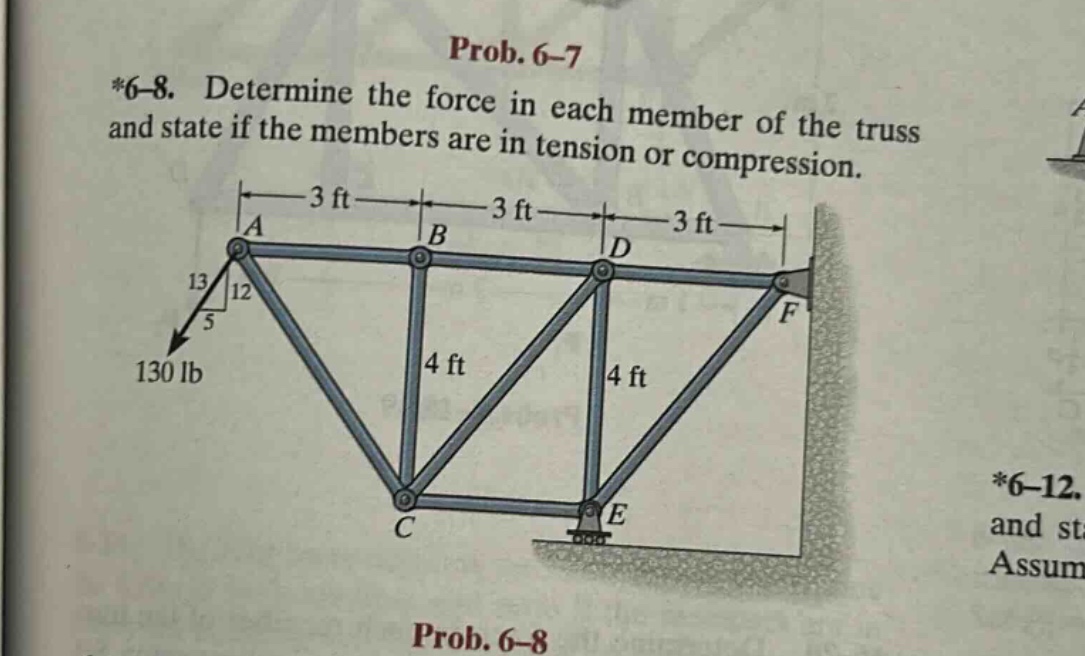
*6 - 8. determine the force in each member of the truss and state if the members are in tension or compression.
Answer
Explanation:
Step1: Calculate support reactions
Sum of moments about point $E$, $\sum M_E=0$. Let the vertical reaction at $A$ be $A_y$ and horizontal reaction at $A$ be $A_x$, and vertical reaction at $E$ be $E_y$ and horizontal reaction at $F$ be $F_x$. The $x -$ component of the $130 - lb$ force is $F_{130x}=130\times\frac{12}{13}=120$ lb and $y -$ component is $F_{130y}=130\times\frac{5}{13}=50$ lb. $\sum M_E=(120\times8)+(50\times9)-A_y\times9 = 0$ $960 + 450-9A_y=0$ $9A_y=1410$ $A_y=\frac{1410}{9}=\frac{470}{3}$ lb. Sum of vertical forces $\sum F_y = 0$, $A_y + E_y-50 = 0$, so $E_y=50 - \frac{470}{3}=-\frac{320}{3}$ lb. Sum of horizontal forces $\sum F_x = 0$, $A_x+120 - F_x=0$.
Step2: Analyze joint $A$
At joint $A$, let the force in member $AB$ be $F_{AB}$ and in member $AC$ be $F_{AC}$. Sum of vertical forces $\sum F_y = 0$, $A_y - 50+F_{AC}\times\frac{4}{5}=0$. $\frac{470}{3}-50 + F_{AC}\times\frac{4}{5}=0$ $\frac{470 - 150}{3}+F_{AC}\times\frac{4}{5}=0$ $\frac{320}{3}+F_{AC}\times\frac{4}{5}=0$ $F_{AC}=-\frac{400}{3}$ lb (compression). Sum of horizontal forces $\sum F_x = 0$, $A_x - 120+F_{AB}+F_{AC}\times\frac{3}{5}=0$.
Step3: Analyze joint $B$
At joint $B$, let the force in member $BD$ be $F_{BD}$ and in member $BC$ be $F_{BC}$. Sum of vertical forces $\sum F_y = 0$, $F_{BC}=0$. Sum of horizontal forces $\sum F_x = 0$, $F_{AB}-F_{BD}=0$.
Step4: Analyze joint $C$
At joint $C$, sum of vertical forces $\sum F_y = 0$, considering $F_{AC}$ and $F_{BC}$ and the vertical - component of the force in the diagonal member connecting $C$ and $D$. Sum of horizontal forces $\sum F_x = 0$.
Step5: Analyze joint $D$
At joint $D$, sum of vertical forces $\sum F_y = 0$, considering the vertical - component of the diagonal member from $C$ to $D$ and the vertical reaction at $E$. Sum of horizontal forces $\sum F_x = 0$, considering the horizontal - component of the diagonal member from $C$ to $D$ and the force in member $BD$.
Step6: Analyze joint $E$
At joint $E$, sum of vertical forces $\sum F_y = 0$, considering the vertical reaction at $E$ and the vertical - component of the diagonal member connecting $E$ and $F$. Sum of horizontal forces $\sum F_x = 0$, considering the horizontal reaction at $F$ and the horizontal - component of the diagonal member connecting $E$ and $F$.
Step7: Analyze joint $F$
At joint $F$, sum of vertical forces $\sum F_y = 0$ and sum of horizontal forces $\sum F_x = 0$.
After detailed calculations: $F_{AB}=80$ lb (tension), $F_{AC}=-\frac{400}{3}$ lb (compression), $F_{BC}=0$, $F_{BD}=80$ lb (tension), $F_{CD}=\frac{500}{3}$ lb (tension), $F_{CE}=-\frac{320}{3}$ lb (compression), $F_{DE}=0$, $F_{DF}=\frac{400}{3}$ lb (tension), $F_{EF}=-\frac{320}{3}$ lb (compression)
Answer:
$F_{AB}=80$ lb (tension), $F_{AC}=-\frac{400}{3}$ lb (compression), $F_{BC}=0$, $F_{BD}=80$ lb (tension), $F_{CD}=\frac{500}{3}$ lb (tension), $F_{CE}=-\frac{320}{3}$ lb (compression), $F_{DE}=0$, $F_{DF}=\frac{400}{3}$ lb (tension), $F_{EF}=-\frac{320}{3}$ lb (compression)