determining the potential and kinetic energy of a roller coaster\ncomplete these sentences.\nif a roller…
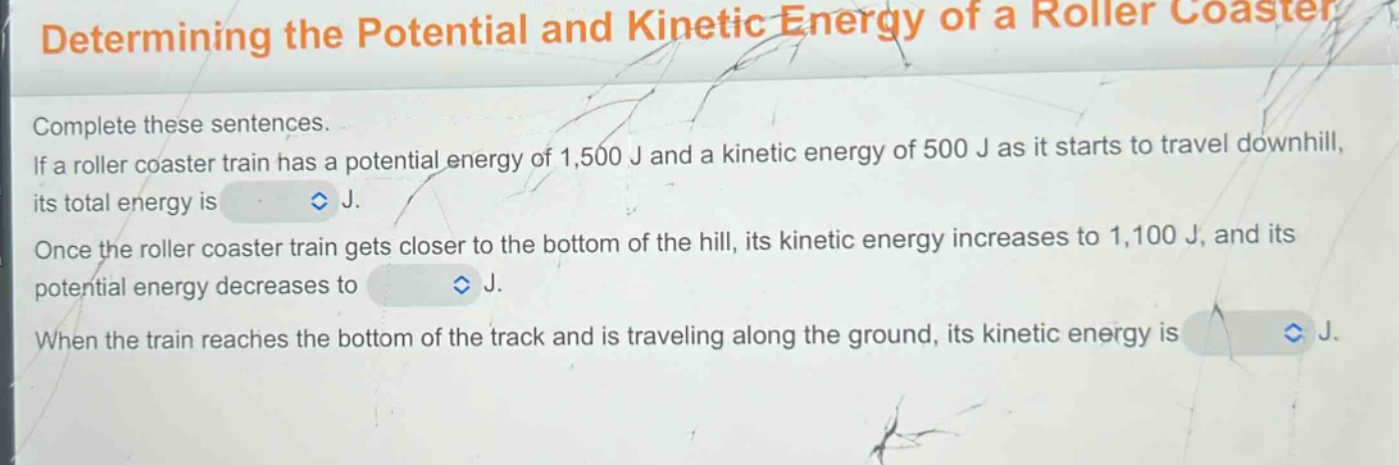
determining the potential and kinetic energy of a roller coaster\ncomplete these sentences.\nif a roller coaster train has a potential energy of 1,500 j and a kinetic energy of 500 j as it starts to travel downhill, its total energy is \nonce the roller coaster train gets closer to the bottom of the hill, its kinetic energy increases to 1,100 j, and its potential energy decreases to \nwhen the train reaches the bottom of the track and is traveling along the ground, its kinetic energy is
Answer
Explanation:
Step1: Calculate initial total energy
The total mechanical - energy $E$ is the sum of potential energy $U$ and kinetic energy $K$. Given $U_1 = 1500\ J$ and $K_1 = 500\ J$, then $E=U_1 + K_1$. $E=1500 + 500=2000\ J$
Step2: Calculate potential energy at second - stage
Since the total energy is conserved ($E = 2000\ J$), and $K_2 = 1100\ J$, we use the formula $E=U_2+K_2$. Then $U_2=E - K_2$. $U_2=2000 - 1100 = 900\ J$
Step3: Calculate kinetic energy at bottom
At the bottom of the track, the potential energy $U_3 = 0\ J$ (assuming ground - level as zero potential level). Since $E = U_3+K_3$ and $E = 2000\ J$, $U_3 = 0\ J$, then $K_3=E - U_3$. $K_3=2000\ J$
Answer:
2000 900 2000