in the diagram, q1 = +2.00 x 10^-5 c, q2 = +3.80 x 10^-6 c, and q3 = +5.30 x 10^-5 c. what is the electric…
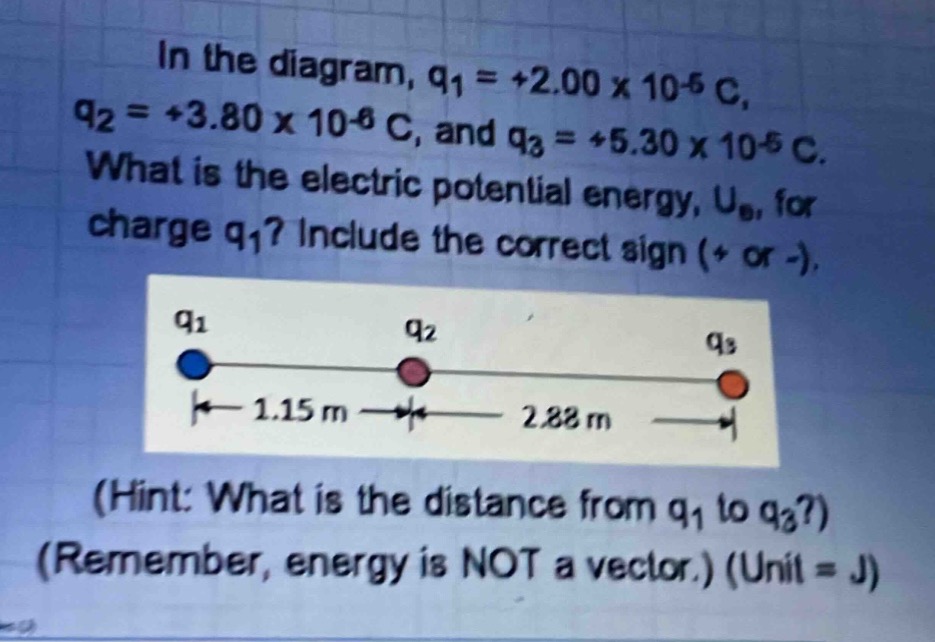
in the diagram, q1 = +2.00 x 10^-5 c, q2 = +3.80 x 10^-6 c, and q3 = +5.30 x 10^-5 c. what is the electric potential energy, ue, for charge q1? include the correct sign (+ or -). (hint: what is the distance from q1 to q3?) (remember, energy is not a vector.) (unit = j)
Answer
Explanation:
Step1: Calculate distance between q1 and q3
The distance $r_{13}$ from $q_1$ to $q_3$ is the sum of the distance from $q_1$ to $q_2$ and from $q_2$ to $q_3$. So $r_{13}=1.15 + 2.88=4.03$ m.
Step2: Use electric - potential - energy formula for two - charges
The electric - potential energy between two charges $q_i$ and $q_j$ is given by $U = k\frac{q_iq_j}{r}$, where $k = 9\times10^{9}\ N\cdot m^{2}/C^{2}$. The electric - potential energy of $q_1$ due to $q_2$ is $U_{12}=k\frac{q_1q_2}{r_{12}}$, and the electric - potential energy of $q_1$ due to $q_3$ is $U_{13}=k\frac{q_1q_3}{r_{13}}$. For $U_{12}$: $q_1 = 2.00\times10^{-5}\ C$, $q_2 = 3.80\times10^{-6}\ C$, $r_{12}=1.15\ m$ $U_{12}=9\times 10^{9}\times\frac{(2.00\times10^{-5})\times(3.80\times10^{-6})}{1.15}$ $U_{12}=9\times 10^{9}\times\frac{7.6\times10^{-11}}{1.15}=9\times10^{9}\times6.6087\times10^{-11}= 0.594783\ J$ For $U_{13}$: $q_1 = 2.00\times10^{-5}\ C$, $q_3 = 5.30\times10^{-5}\ C$, $r_{13}=4.03\ m$ $U_{13}=9\times 10^{9}\times\frac{(2.00\times10^{-5})\times(5.30\times10^{-5})}{4.03}$ $U_{13}=9\times 10^{9}\times\frac{1.06\times10^{-9}}{4.03}=9\times10^{9}\times2.6303\times10^{-10}=2.36727\ J$
Step3: Calculate total electric - potential energy of q1
The total electric - potential energy of $q_1$ is $U_{e}=U_{12}+U_{13}$. $U_{e}=0.594783 + 2.36727=2.962053\approx2.96\ J$
Answer:
$+ 2.96\ J$