in the diagram, q1 = +3.25*10^(-9) c. what is the potential difference when you go from point b to point a…
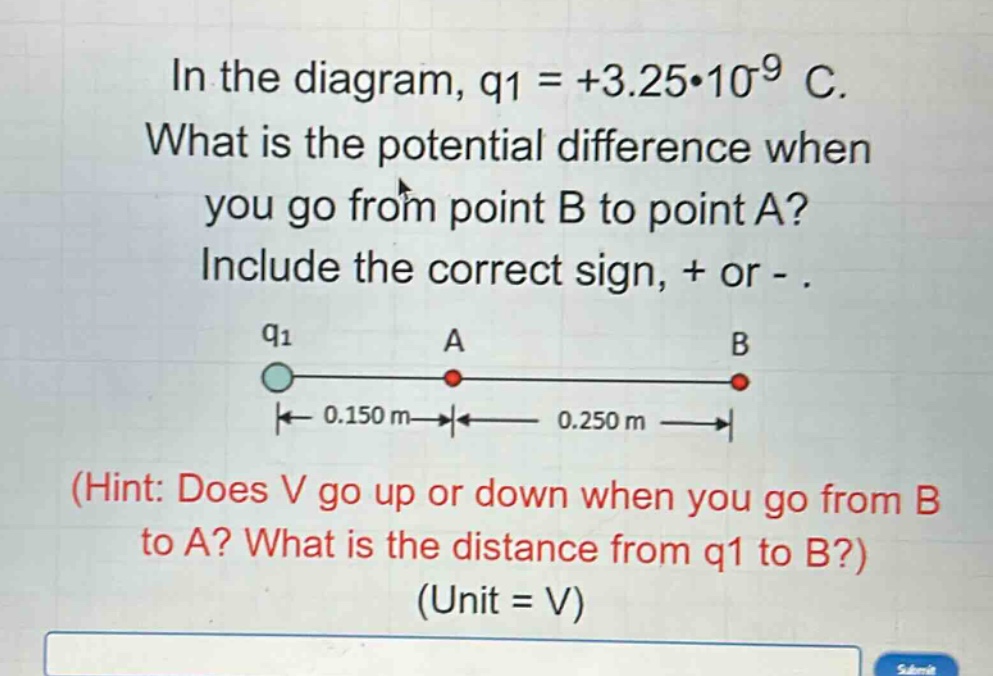
in the diagram, q1 = +3.25*10^(-9) c. what is the potential difference when you go from point b to point a? include the correct sign, + or -.\n(hint: does v go up or down when you go from b to a? what is the distance from q1 to b?)\n(unit = v)
Answer
Explanation:
Step1: Calculate the electric potential at point A.
The potential $V_A$ at point A due to charge $q_1$ is given by the formula $V = k \frac{q}{r}$, where $k = 8.99 \times 10^9 , \text{N} \cdot \text{m}^2/\text{C}^2$, $q_1 = +3.25 \times 10^{-9} , \text{C}$ (assuming a typo correction from $10^9$ to $10^{-9}$), and $r_A = 0.150 , \text{m}$. $$ V_A = k \frac{q_1}{r_A} = (8.99 \times 10^9 , \text{N} \cdot \text{m}^2/\text{C}^2) \frac{3.25 \times 10^{-9} , \text{C}}{0.150 , \text{m}} $$ $$ V_A \approx 194.78 , \text{V} $$
Step2: Calculate the electric potential at point B.
The distance from $q_1$ to point B is $r_B = 0.150 , \text{m} + 0.250 , \text{m} = 0.400 , \text{m}$. The potential $V_B$ at point B is: $$ V_B = k \frac{q_1}{r_B} = (8.99 \times 10^9 , \text{N} \cdot \text{m}^2/\text{C}^2) \frac{3.25 \times 10^{-9} , \text{C}}{0.400 , \text{m}} $$ $$ V_B \approx 73.04 , \text{V} $$
Step3: Calculate the potential difference from B to A.
The potential difference when going from point B to point A is $V_{AB} = V_A - V_B$. $$ V_{AB} = V_A - V_B \approx 194.78 , \text{V} - 73.04 , \text{V} $$ $$ V_{AB} \approx +121.74 , \text{V} $$
Answer:
$+121.74 , \text{V}$