in the diagram, q1 = +6.39 × 10^(-9)c and q2 = +3.22 × 10^(-9)c. what is the electric field at point p…
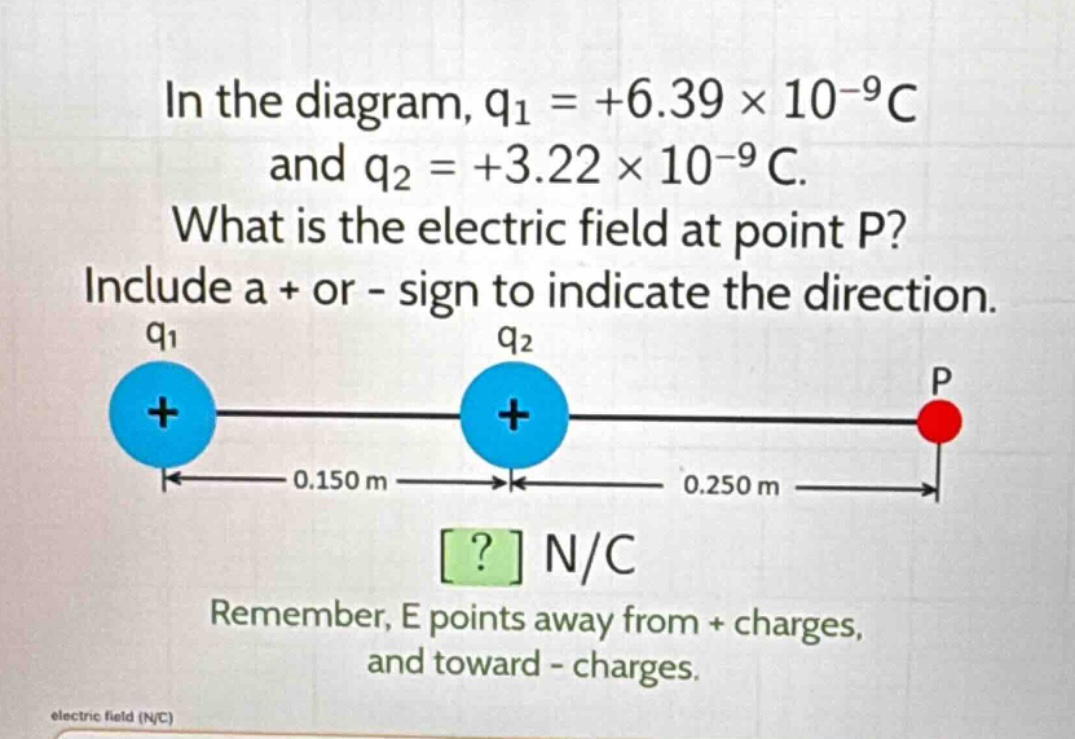
in the diagram, q1 = +6.39 × 10^(-9)c and q2 = +3.22 × 10^(-9)c. what is the electric field at point p? include a + or - sign to indicate the direction. remember, e points away from + charges, and toward - charges.
Answer
Explanation:
Step1: Recall electric - field formula
The electric - field due to a point charge is given by $E = k\frac{q}{r^{2}}$, where $k = 9\times10^{9}\ N\cdot m^{2}/C^{2}$, $q$ is the charge, and $r$ is the distance from the charge to the point of interest.
Step2: Calculate the electric field due to $q_1$
The distance from $q_1$ to point $P$ is $r_1=0.150 + 0.250=0.400\ m$. Using the formula $E_1 = k\frac{q_1}{r_1^{2}}$, we substitute $k = 9\times10^{9}\ N\cdot m^{2}/C^{2}$, $q_1 = 6.39\times10^{-9}\ C$, and $r_1 = 0.400\ m$. $E_1=9\times10^{9}\times\frac{6.39\times10^{-9}}{(0.400)^{2}}=\frac{9\times6.39}{0.16}=359.4375\ N/C$.
Step3: Calculate the electric field due to $q_2$
The distance from $q_2$ to point $P$ is $r_2 = 0.250\ m$. Using the formula $E_2=k\frac{q_2}{r_2^{2}}$, we substitute $k = 9\times10^{9}\ N\cdot m^{2}/C^{2}$, $q_2 = 3.22\times10^{-9}\ C$, and $r_2 = 0.250\ m$. $E_2=9\times10^{9}\times\frac{3.22\times10^{-9}}{(0.250)^{2}}=\frac{9\times3.22}{0.0625}=463.68\ N/C$.
Step4: Find the net electric field
Since both charges are positive and the electric - field due to a positive charge points away from the charge, the net electric field at point $P$ is $E = E_1+E_2$. $E=359.4375 + 463.68=823.1175\ N/C$. Since the electric field points away from the positive charges (towards the right in the given diagram), the sign is positive.
Answer:
$+ 823\ N/C$