in the diagram, q1 = -1.75 μc and q2 = -2.25 μc. what is the electric field at point p? include a + or…
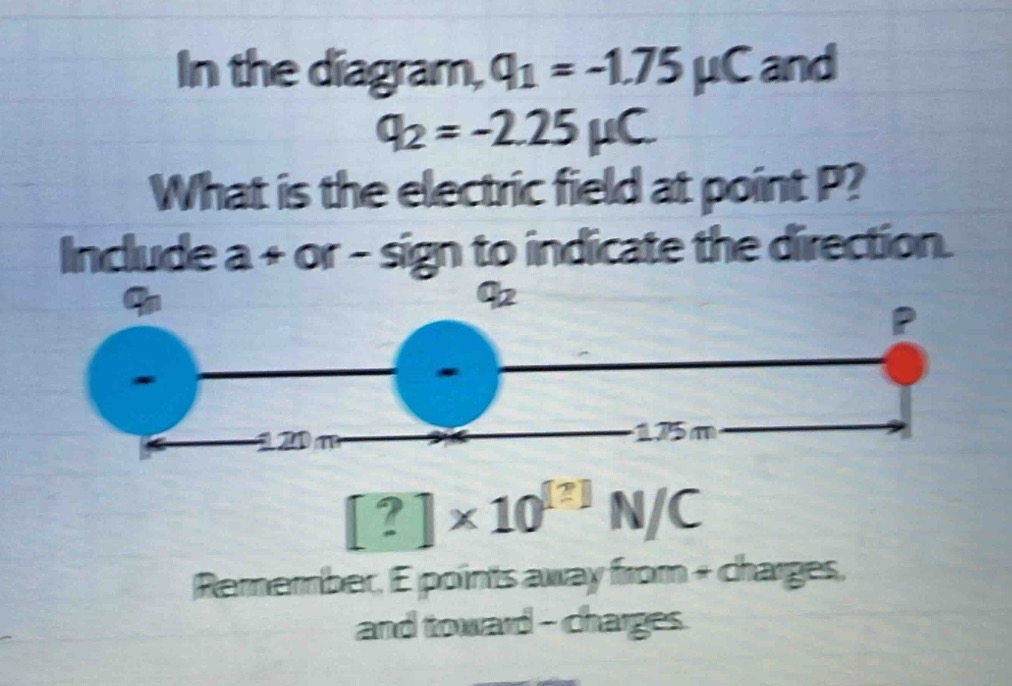
in the diagram, q1 = -1.75 μc and q2 = -2.25 μc. what is the electric field at point p? include a + or - sign to indicate the direction. remember, e points away from + charges and toward - charges.
Answer
Explanation:
Step1: Recall electric - field formula
The electric - field due to a point charge is given by $E = k\frac{|q|}{r^{2}}$, where $k = 9\times10^{9}\ N\cdot m^{2}/C^{2}$, $q$ is the charge, and $r$ is the distance from the charge to the point of interest.
Step2: Calculate the electric - field due to $q_1$
The distance from $q_1$ to point $P$ is $r_1=1.20 + 1.75=2.95\ m$. The charge $q_1=- 1.75\times10^{-6}\ C$. Using the formula $E_1 = k\frac{|q_1|}{r_1^{2}}$, we have $E_1=(9\times10^{9})\frac{1.75\times10^{-6}}{(2.95)^{2}}$. [ \begin{align*} E_1&=(9\times10^{9})\frac{1.75\times10^{-6}}{8.7025}\ &=\frac{15.75\times10^{3}}{8.7025}\ &\approx1.81\times10^{3}\ N/C \end{align*} ] Since $q_1$ is negative, the electric - field $E_1$ points towards $q_1$.
Step3: Calculate the electric - field due to $q_2$
The distance from $q_2$ to point $P$ is $r_2 = 1.75\ m$. The charge $q_2=-2.25\times10^{-6}\ C$. Using the formula $E_2 = k\frac{|q_2|}{r_2^{2}}$, we have $E_2=(9\times10^{9})\frac{2.25\times10^{-6}}{(1.75)^{2}}$. [ \begin{align*} E_2&=(9\times10^{9})\frac{2.25\times10^{-6}}{3.0625}\ &=\frac{20.25\times10^{3}}{3.0625}\ &\approx6.61\times10^{3}\ N/C \end{align*} ] Since $q_2$ is negative, the electric - field $E_2$ points towards $q_2$.
Step4: Calculate the net electric - field
Since both $E_1$ and $E_2$ point towards the left (towards the negative charges), the net electric - field $E = E_1+E_2$. $E=(1.81\times10^{3}+6.61\times10^{3})\ N/C = 8.42\times10^{3}\ N/C$. The direction is towards the negative charges, so we use a negative sign.
Answer:
$- 8.42\times10^{3}$