the diagrams represent bulb brightness using starbursts and current using arrowtails. give attention to the…
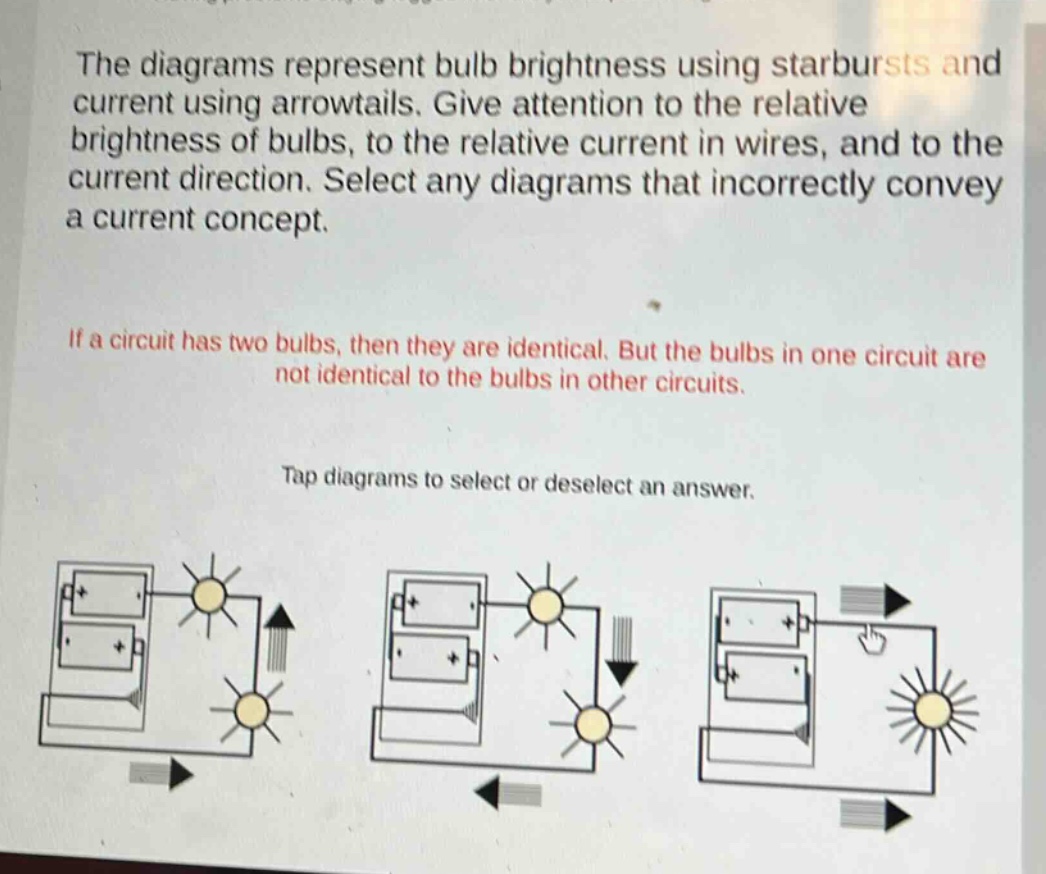
the diagrams represent bulb brightness using starbursts and current using arrowtails. give attention to the relative brightness of bulbs, to the relative current in wires, and to the current direction. select any diagrams that incorrectly convey a current concept.\nif a circuit has two bulbs, then they are identical. but the bulbs in one circuit are not identical to the bulbs in other circuits.\ntap diagrams to select or deselect an answer.
Answer
Explanation:
Step1: Recall current - brightness relationship
In a circuit, for identical bulbs, more current means more brightness. Also, in a series circuit, the current is the same throughout, and in a parallel - like situation (if applicable), the current divides according to the resistance.
Step2: Analyze first diagram
If the bulbs are identical and in series, they should have the same brightness and the current arrows should show equal current through both bulbs and the wires connecting them. If the arrows show different currents in different parts of the series - connected wires or different brightness for identical bulbs in series, it is incorrect.
Step3: Analyze second diagram
Similar to the first, check for consistency in current direction and magnitude for series - connected identical bulbs. Incorrect current concepts would be if the current arrows do not match the expected behavior for series or parallel circuits and the brightness does not correspond to the current.
Step4: Analyze third diagram
Check if the current direction makes sense with the battery polarity and if the brightness of the bulb is consistent with the amount of current indicated by the arrowtails. If the current is shown flowing in an incorrect direction relative to the battery or if the brightness - current relationship is violated, it is incorrect.
Without seeing the actual current and brightness details precisely, we assume that we are looking for violations of basic circuit principles such as: incorrect current direction (current should flow from positive to negative terminal of the battery in the external circuit), inconsistent current magnitudes in series (should be same) or parallel (should divide according to resistance) for identical bulbs, and incorrect brightness - current relationships (more current means brighter bulb for identical bulbs).
Since no specific details about what is wrong with the diagrams are given in the question prompt itself, we need to rely on these general principles. If we assume that the diagrams are supposed to represent simple series circuits with identical bulbs:
- In a series circuit, the current is the same everywhere in the circuit. So, if the arrowtails representing current show different magnitudes in different parts of the series - connected wires, the diagram is incorrect.
- Since the bulbs are identical in a given circuit, they should have the same brightness. If one bulb is shown brighter than the other in a series - connected circuit with identical bulbs, the diagram is incorrect.