the diagrams below show two pure samples of gas in identical closed containers. the colored balls represent…
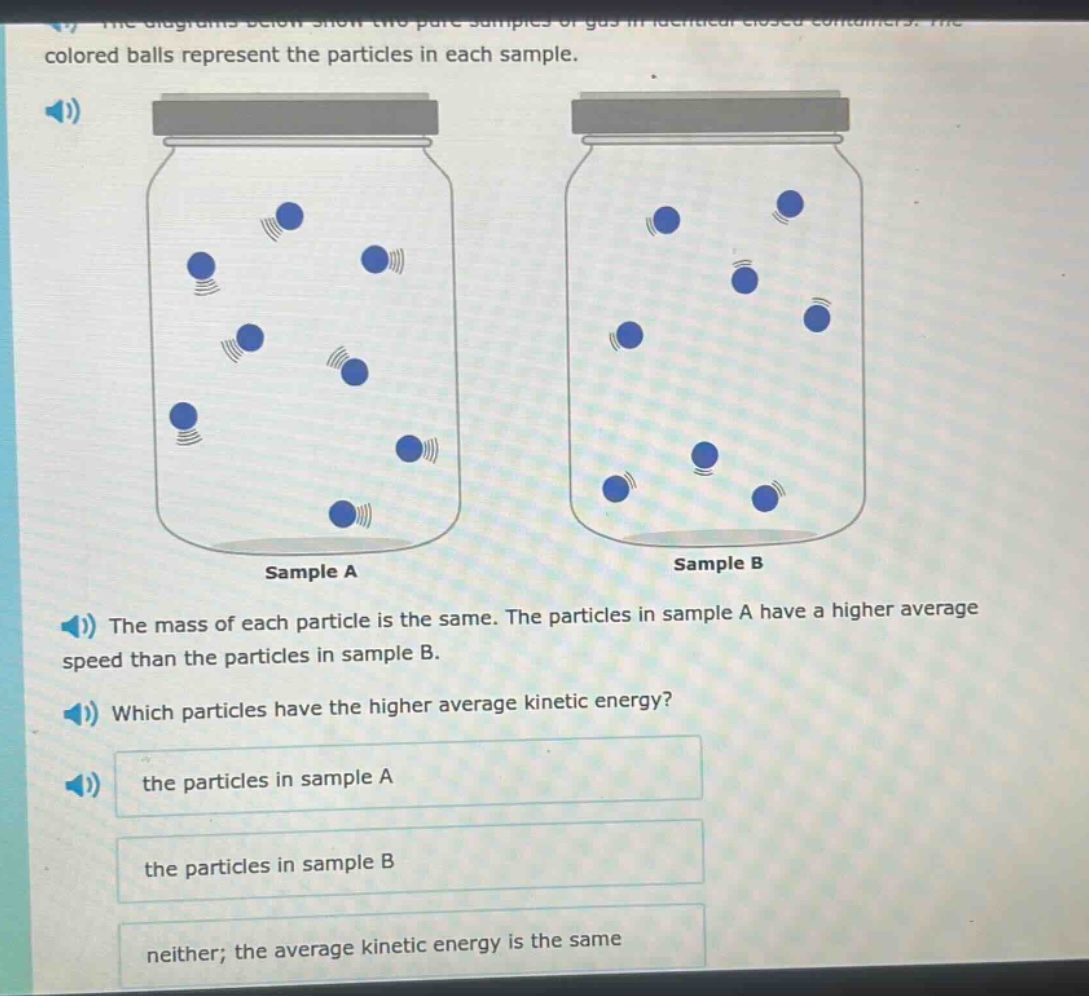
the diagrams below show two pure samples of gas in identical closed containers. the colored balls represent the particles in each sample. sample a sample b the mass of each particle is the same. the particles in sample a have a higher average speed than the particles in sample b. which particles have the higher average kinetic energy? the particles in sample a the particles in sample b neither; the average kinetic energy is the same
Answer
Explanation:
Step1: Recall kinetic - energy formula
The formula for kinetic energy is $K = \frac{1}{2}mv^{2}$, where $m$ is mass and $v$ is speed.
Step2: Compare samples
Given that the mass $m$ of each particle is the same, and the particles in sample A have a higher average speed $v$ than the particles in sample B. Since $K\propto v^{2}$ (when $m$ is constant), the particles in sample A have higher average kinetic energy.
Answer:
the particles in sample A