the diagrams below show two pure samples of gas in identical closed, rigid containers. gas a gas b gas b has…
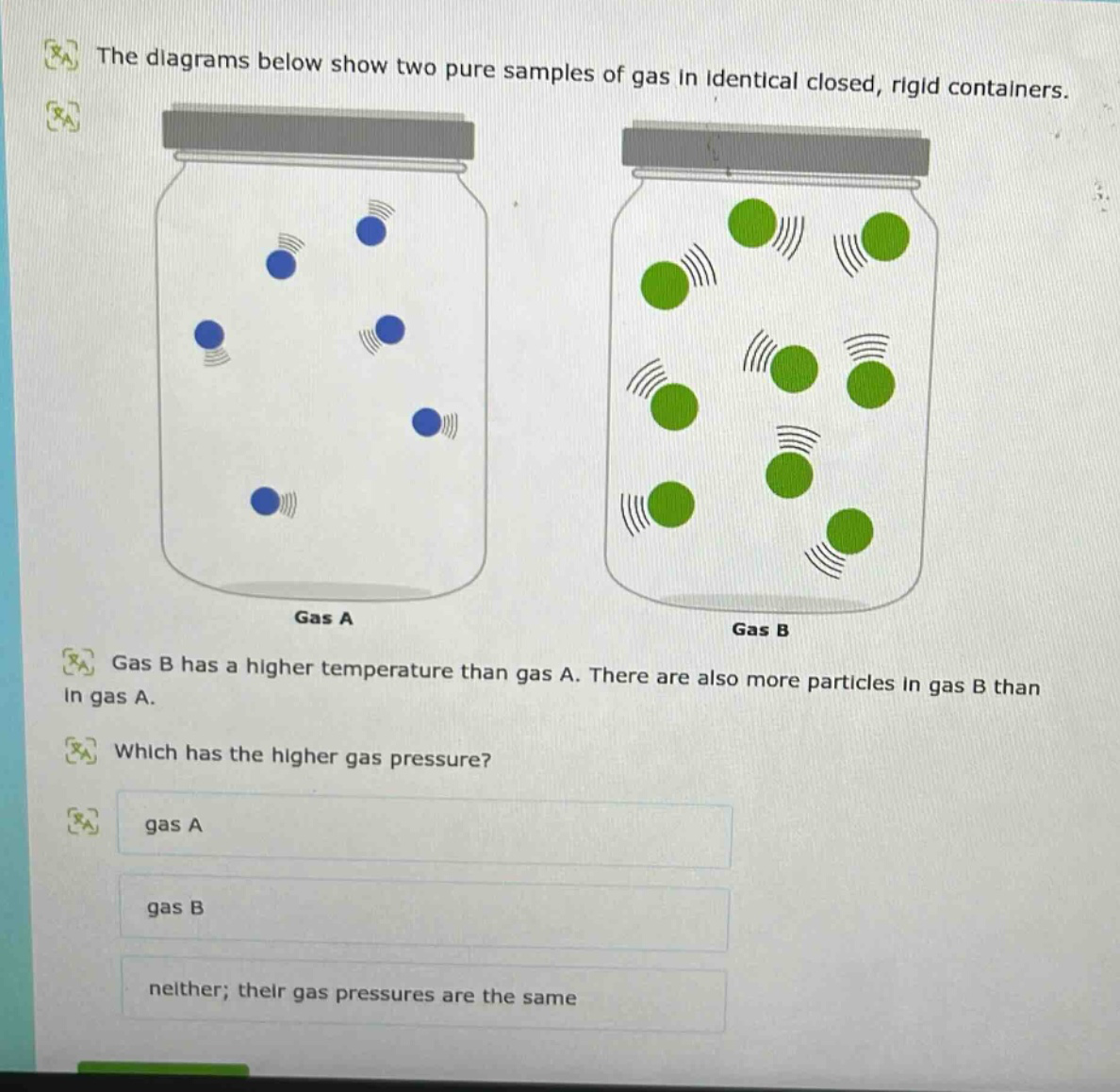
the diagrams below show two pure samples of gas in identical closed, rigid containers. gas a gas b gas b has a higher temperature than gas a. there are also more particles in gas b than in gas a. which has the higher gas pressure? gas a gas b neither; their gas pressures are the same
Answer
Explanation:
Step1: Consider la ley de los gases ideales
$PV = nRT$, donde $P$ es la presión, $V$ el volumen, $n$ la cantidad de sustancia, $R$ la constante de los gases ideales y $T$ la temperatura.
Step2: Analizar los datos dados
Los envases son idénticos (volumen $V$ constante), y se tratan de gases puros. Gas B tiene una temperatura $T$ más alta y una cantidad de partículas (y por tanto $n$) mayor que gas A.
Step3: Deducir la presión
Según la ecuación $P=\frac{nRT}{V}$, con $V$ constante, un aumento en $n$ y $T$ implica un aumento en $P$. Entonces, gas B tendrá una presión mayor.
Answer:
gas B