directions: circle the term that correctly completes the sentence.\n6. electromagnetic waves are made by…
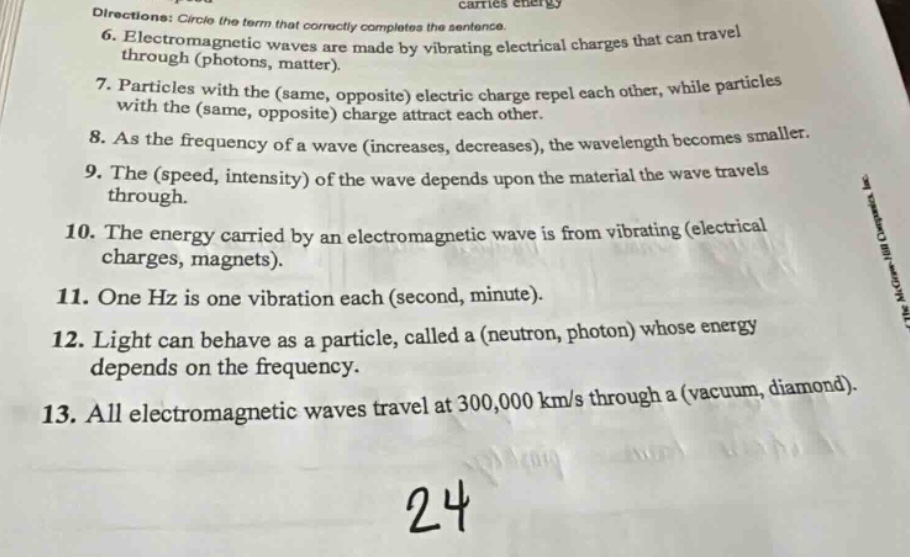
directions: circle the term that correctly completes the sentence.\n6. electromagnetic waves are made by vibrating electrical charges that can travel through (photons, matter).\n7. particles with the (same, opposite) electric charge repel each other, while particles with the (same, opposite) charge attract each other.\n8. as the frequency of a wave (increases, decreases), the wavelength becomes smaller.\n9. the (speed, intensity) of the wave depends upon the material the wave travels through.\n10. the energy carried by an electromagnetic wave is from vibrating (electrical charges, magnets).\n11. one hz is one vibration each (second, minute).\n12. light can behave as a particle, called a (neutron, photon) whose energy depends on the frequency.\n13. all electromagnetic waves travel at 300,000 km/s through a (vacuum, diamond).
Answer
Brief Explanations:
- Electromagnetic waves are made of photons and can travel through a vacuum, not just matter.
- Like - charged particles repel, opposite - charged particles attract.
- The frequency and wavelength of a wave are inversely proportional.
- The speed of a wave depends on the medium it travels through.
- The energy of an electromagnetic wave comes from vibrating electrical charges.
- Hertz (Hz) is the unit of frequency, and 1 Hz means 1 vibration per second.
- Light can behave as a particle called a photon, not a neutron.
- Electromagnetic waves travel at the speed of light (300,000 km/s) in a vacuum.
Answer:
- photons
- same; opposite
- increases
- speed
- electrical charges
- second
- photon
- vacuum