directions: solve the problem shown below. any data, calculations, or models you use to support your…
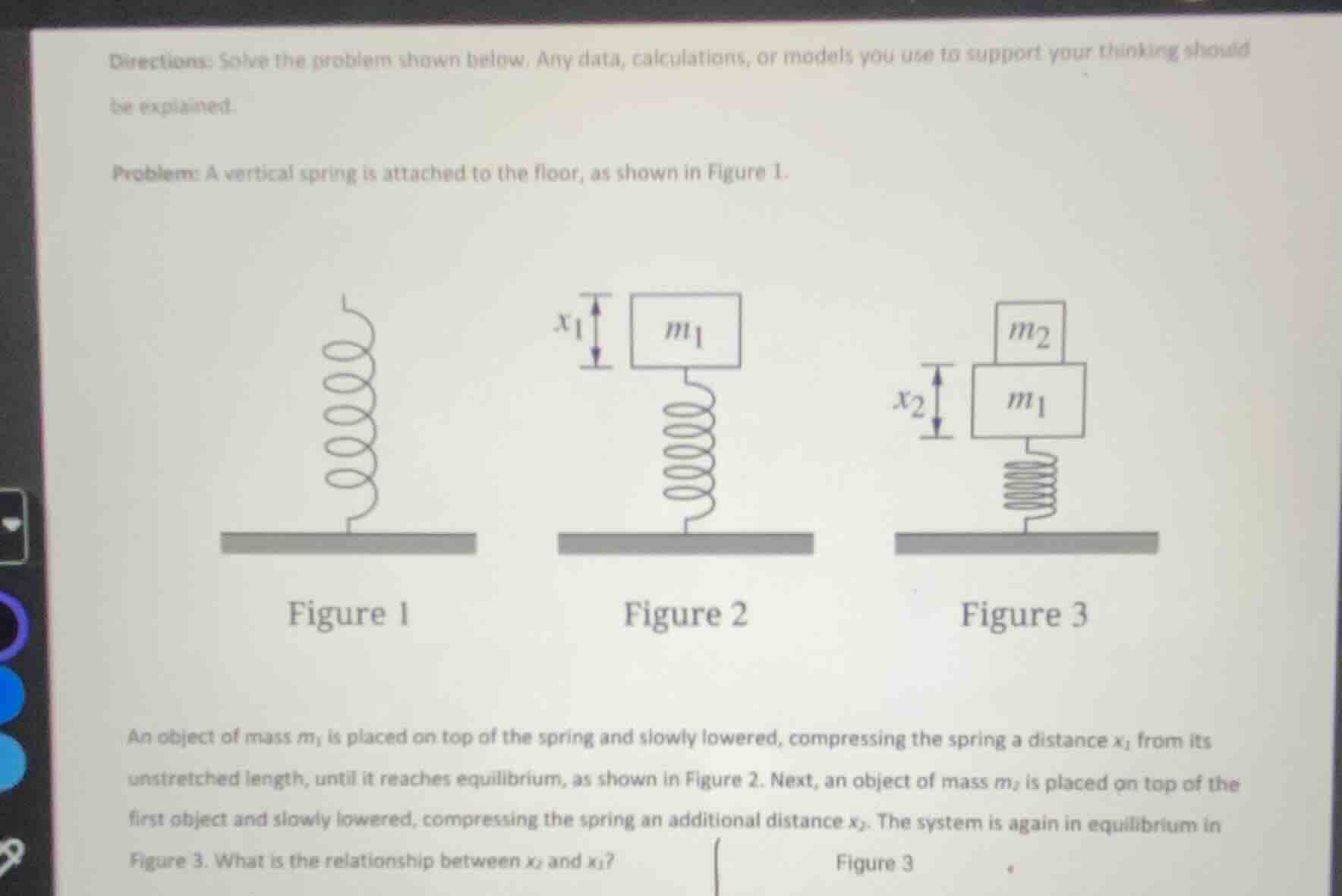
directions: solve the problem shown below. any data, calculations, or models you use to support your thinking should be explained. problem: a vertical spring is attached to the floor, as shown in figure 1. an object of mass ( m_1 ) is placed on top of the spring and slowly lowered, compressing the spring a distance ( x_1 ) from its unstretched length, until it reaches equilibrium, as shown in figure 2. next, an object of mass ( m_2 ) is placed on top of the first object and slowly lowered, compressing the spring an additional distance ( x_2 ). the system is again in equilibrium in figure 3. what is the relationship between ( x_2 ) and ( x_1 )?
Answer
Explanation:
Step1: Analyze equilibrium for ( m_1 )
When only ( m_1 ) is on the spring, at equilibrium, the spring force equals the weight of ( m_1 ). Using Hooke's Law ( F = kx ) (where ( k ) is the spring constant and ( x ) is the compression) and Newton's second law (net force is zero), we have:
( kx_1 = m_1g ) (1)
Step2: Analyze equilibrium for ( m_1 + m_2 )
When ( m_2 ) is added on top of ( m_1 ), the total compression is ( x_1 + x_2 ). At equilibrium, the spring force equals the total weight of ( m_1 ) and ( m_2 ):
( k(x_1 + x_2) = (m_1 + m_2)g ) (2)
Step3: Solve for ( x_2 ) in terms of ( x_1 )
Expand equation (2): ( kx_1 + kx_2 = m_1g + m_2g ). From equation (1), we know ( kx_1 = m_1g ). Substitute ( kx_1 ) in equation (2) with ( m_1g ):
( m_1g + kx_2 = m_1g + m_2g ).
Subtract ( m_1g ) from both sides: ( kx_2 = m_2g ).
Now, from equation (1), ( k = \frac{m_1g}{x_1} ). Substitute ( k ) into ( kx_2 = m_2g ):
( \frac{m_1g}{x_1} \cdot x_2 = m_2g ).
Cancel ( g ) from both sides: ( \frac{m_1x_2}{x_1} = m_2 ).
Rearrange to solve for ( x_2 ): ( x_2 = \frac{m_2}{m_1}x_1 ).
(Note: If we assume ( m_2 = m_1 ) (though not stated, a common case for proportionality), ( x_2 = x_1 ). But generally, ( x_2 ) is proportional to ( x_1 ) with the ratio ( \frac{m_2}{m_1} ). However, if the problem implies ( m_2 = m_1 ) (e.g., equal masses), then ( x_2 = x_1 ).)
Answer:
If ( m_2 = m_1 ), then ( \boldsymbol{x_2 = x_1} ). More generally, ( \boldsymbol{x_2 = \frac{m_2}{m_1}x_1} ) (proportional to ( x_1 ) with ratio ( \frac{m_2}{m_1} )).