the displacement, $d$, in millimeters of a tuning fork as a function of time, $t$, in seconds can be modeled…
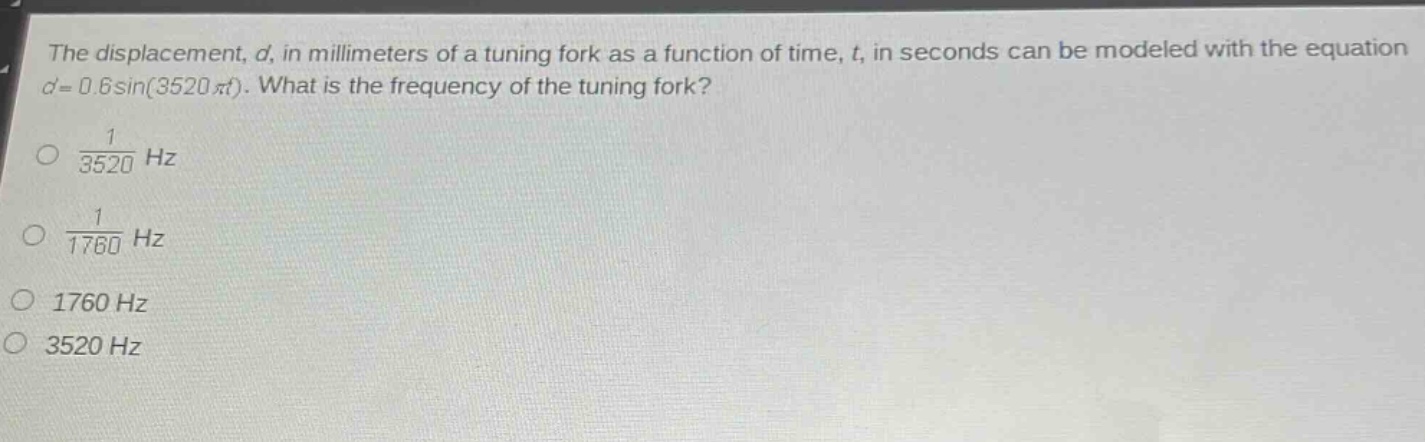
the displacement, $d$, in millimeters of a tuning fork as a function of time, $t$, in seconds can be modeled with the equation $d = 0.6sin(3520pi t)$. what is the frequency of the tuning fork?\n$\frac{1}{3520}\text{ hz}$\n$\frac{1}{1760}\text{ hz}$\n$1760\text{ hz}$\n$3520\text{ hz}$
Answer
Explanation:
Step1: Recall the sine - wave formula
The general form of a sine - wave for simple harmonic motion is $d = A\sin(\omega t)$, where $\omega$ is the angular frequency. In the given equation $d = 0.6\sin(3520\pi t)$, we have $\omega=3520\pi$.
Step2: Use the relationship between angular frequency and frequency
The relationship between angular frequency $\omega$ and frequency $f$ is $\omega = 2\pi f$. We need to solve for $f$. Rearranging the formula $f=\frac{\omega}{2\pi}$.
Step3: Substitute the value of $\omega$
Substitute $\omega = 3520\pi$ into the formula $f=\frac{\omega}{2\pi}$. Then $f=\frac{3520\pi}{2\pi}$.
Step4: Simplify the expression
Cancel out the $\pi$ terms: $\frac{3520\pi}{2\pi}=\frac{3520}{2}=1760$ Hz.
Answer:
C. 1760 Hz