a dog named rascal leaves his home and travels a short distance and then returns home. the graph shows his…
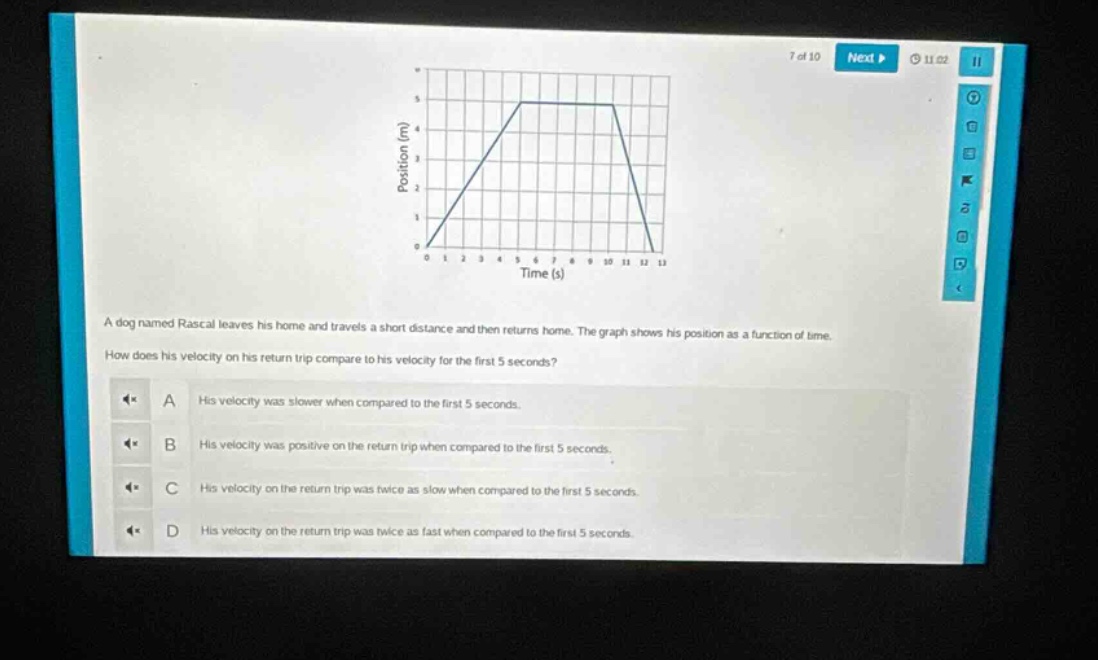
a dog named rascal leaves his home and travels a short distance and then returns home. the graph shows his position as a function of time. how does his velocity on his return trip compare to his velocity for the first 5 seconds? a his velocity was slower when compared to the first 5 seconds. b his velocity was positive on the return trip when compared to the first 5 seconds. c his velocity on the return trip was twice as slow when compared to the first 5 seconds. d his velocity on the return trip was twice as fast when compared to the first 5 seconds.
Answer
Explanation:
Step1: Recall velocity - slope relation
Velocity is the slope of the position - time graph.
Step2: Calculate slope for first 5 seconds
For the first 5 seconds, the position changes from 0 m to 5 m in 5 s. Slope $m_1=\frac{5 - 0}{5-0}=1$ m/s.
Step3: Calculate slope for return trip
For the return trip (from $t = 10$ s to $t = 15$ s), the position changes from 5 m to 0 m. Slope $m_2=\frac{0 - 5}{15 - 10}=- 1$ m/s. The magnitude of $m_1$ and $m_2$ is the same.
Step4: Analyze options
Option A is wrong as magnitudes are equal. Option B is wrong as velocity on return trip is negative. Option C is wrong as magnitudes are equal. Option D is correct as the magnitude of velocity on return trip is the same as the first 5 seconds in magnitude and since the dog is moving back (opposite direction), we can consider the concept of speed (magnitude of velocity) and say it is "as fast" in a sense of magnitude comparison.
Answer:
D. His velocity on the return trip was twice as fast when compared to the first 5 seconds.