drag each label to the correct location on the chart. based on newtons law of universal gravitation…
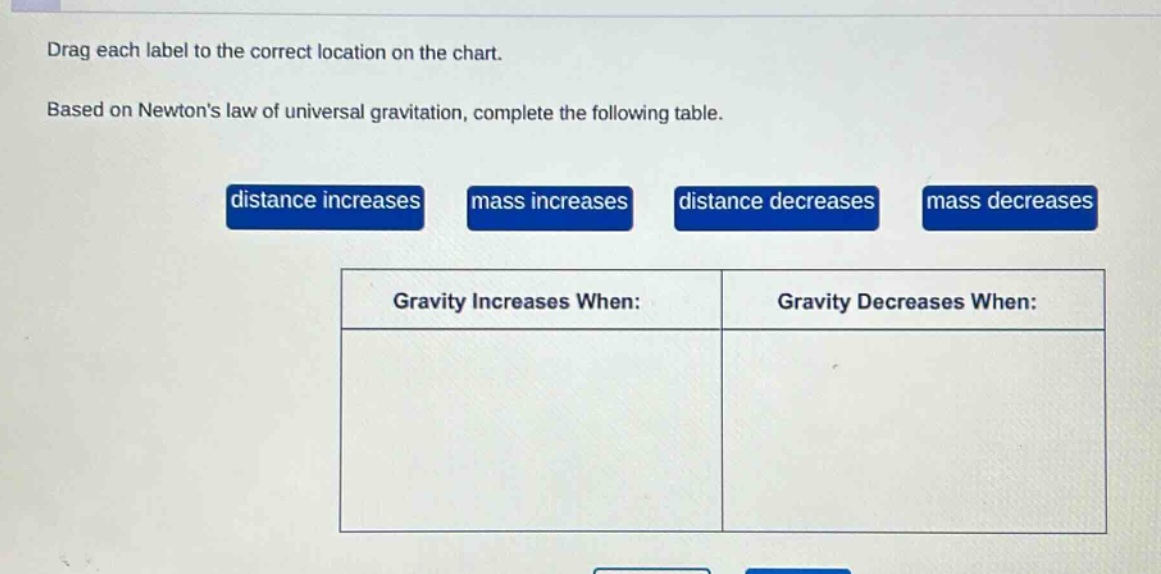
drag each label to the correct location on the chart. based on newtons law of universal gravitation, complete the following table. distance increases mass increases distance decreases mass decreases gravity increases when: gravity decreases when:
Answer
Explanation:
Step1: Recall Newton's law of universal gravitation
Newton's law of universal gravitation is given by the formula (F = G\frac{m_1m_2}{r^2}), where (F) is the gravitational force, (G) is the gravitational constant, (m_1) and (m_2) are the masses of the two objects, and (r) is the distance between their centers of mass.
Step2: Analyze the effect of mass on gravity
From the formula (F = G\frac{m_1m_2}{r^2}), we can see that (F) is directly proportional to the product of the masses ((m_1m_2)). So, when the mass ((m_1) or (m_2)) increases, the gravitational force (F) (gravity) increases.
Step3: Analyze the effect of distance on gravity
From the formula (F = G\frac{m_1m_2}{r^2}), we can see that (F) is inversely proportional to the square of the distance ((r^2)). So, when the distance ((r)) decreases, the gravitational force (F) (gravity) increases (because (\frac{1}{r^2}) gets larger as (r) gets smaller). Conversely, when the mass ((m_1) or (m_2)) decreases, the gravitational force (F) (gravity) decreases (due to the direct - proportionality). And when the distance ((r)) increases, the gravitational force (F) (gravity) decreases (due to the inverse - square relationship).
Answer:
| Gravity Increases When: | Gravity Decreases When: |
|---|---|
| mass increases, distance decreases | distance increases, mass decreases |