drag each label to the correct location on the table. classify each planet as an inner planet or an outer…
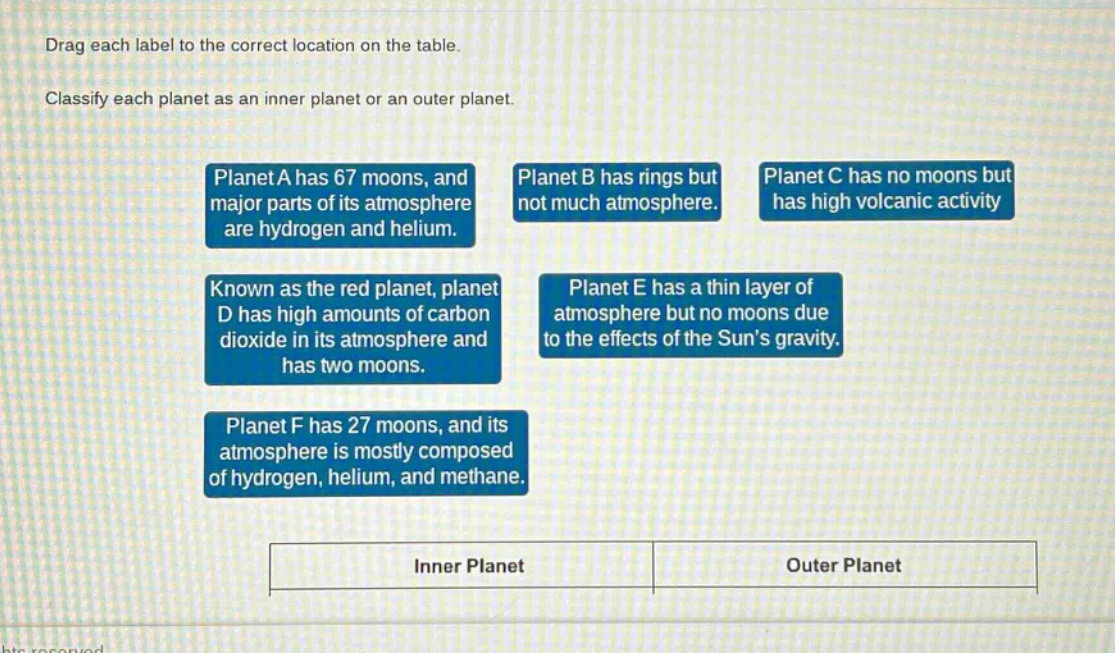
drag each label to the correct location on the table. classify each planet as an inner planet or an outer planet. planet a has 67 moons, and major parts of its atmosphere are hydrogen and helium. planet b has rings but not much atmosphere. planet c has no moons but has high volcanic activity. known as the red planet, planet d has high amounts of carbon dioxide in its atmosphere and has two moons. planet e has a thin layer of atmosphere but no moons due to the effects of the suns gravity. planet f has 27 moons, and its atmosphere is mostly composed of hydrogen, helium, and methane. inner planet outer planet
Answer
Answer:
Inner Planet: Planet C, Planet D, Planet E Outer Planet: Planet A, Planet B, Planet F
Explanation:
Step1: Recall inner - outer planet facts
Inner planets (Mercury, Venus, Earth, Mars) are closer to the Sun, generally smaller, have few or no moons, and are rocky. Outer planets (Jupiter, Saturn, Uranus, Neptune) are farther from the Sun, larger, have many moons, and are gas - giants or ice - giants.
Step2: Analyze Planet A
Planet A has 67 moons and its atmosphere is mainly hydrogen and helium. This is characteristic of an outer planet like Jupiter. So it is an outer planet.
Step3: Analyze Planet B
Planet B has rings but not much atmosphere. Saturn is known for its rings and is an outer planet. So it is an outer planet.
Step4: Analyze Planet C
Planet C has no moons but high volcanic activity. Inner planets like Mercury and Venus have no or few moons and volcanic activity can occur on them. So it is an inner planet.
Step5: Analyze Planet D
Planet D is the red planet (Mars) with high amounts of carbon dioxide in its atmosphere and two moons. Mars is an inner planet. So it is an inner planet.
Step6: Analyze Planet E
Planet E has a thin layer of atmosphere and no moons due to the Sun's gravity. Inner planets can have thin atmospheres and be affected by the Sun's gravity in terms of moon - formation. So it is an inner planet.
Step7: Analyze Planet F
Planet F has 27 moons and its atmosphere is mostly hydrogen, helium, and methane. This is similar to Uranus. So it is an outer planet.