drag each tile to the correct box. arrange the events in the life of a star in the correct order. all that…
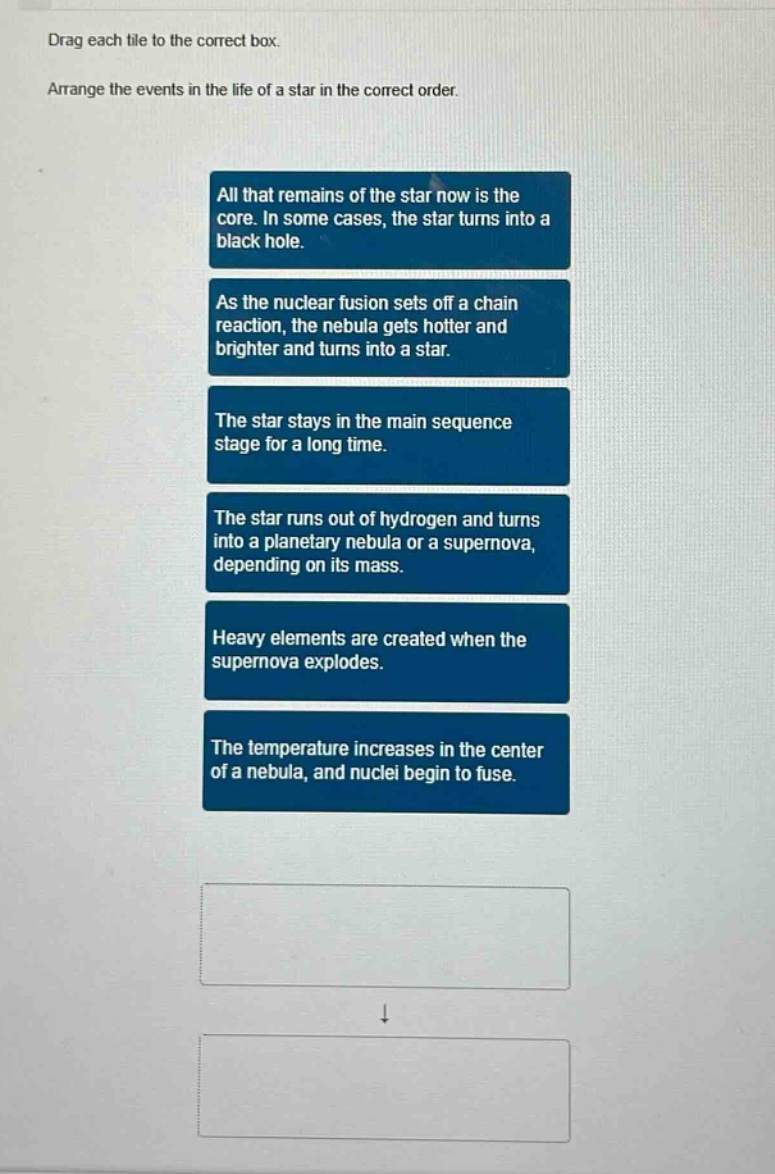
drag each tile to the correct box. arrange the events in the life of a star in the correct order. all that remains of the star now is the core. in some cases, the star turns into a black hole. as the nuclear fusion sets off a chain reaction, the nebula gets hotter and brighter and turns into a star. the star stays in the main sequence stage for a long time. the star runs out of hydrogen and turns into a planetary nebula or a supernova, depending on its mass. heavy elements are created when the supernova explodes. the temperature increases in the center of a nebula, and nuclei begin to fuse.
Answer
Brief Explanations:
The life - cycle of a star starts with the heating up and nuclear fusion in a nebula, then it becomes a star and stays in the main sequence. After running out of hydrogen, it can become a planetary nebula or supernova. Supernova explosions create heavy elements, and finally, only the core remains, which can become a black hole in some cases.
Answer:
- The temperature increases in the center of a nebula, and nuclei begin to fuse.
- As the nuclear fusion sets off a chain reaction, the nebula gets hotter and brighter and turns into a star.
- The star stays in the main sequence stage for a long time.
- The star runs out of hydrogen and turns into a planetary nebula or a supernova, depending on its mass.
- Heavy elements are created when the supernova explodes.
- All that remains of the star now is the core. In some cases, the star turns into a black hole.