drag each tile to the correct box. arrange the objects in order from greatest to least potential energy…
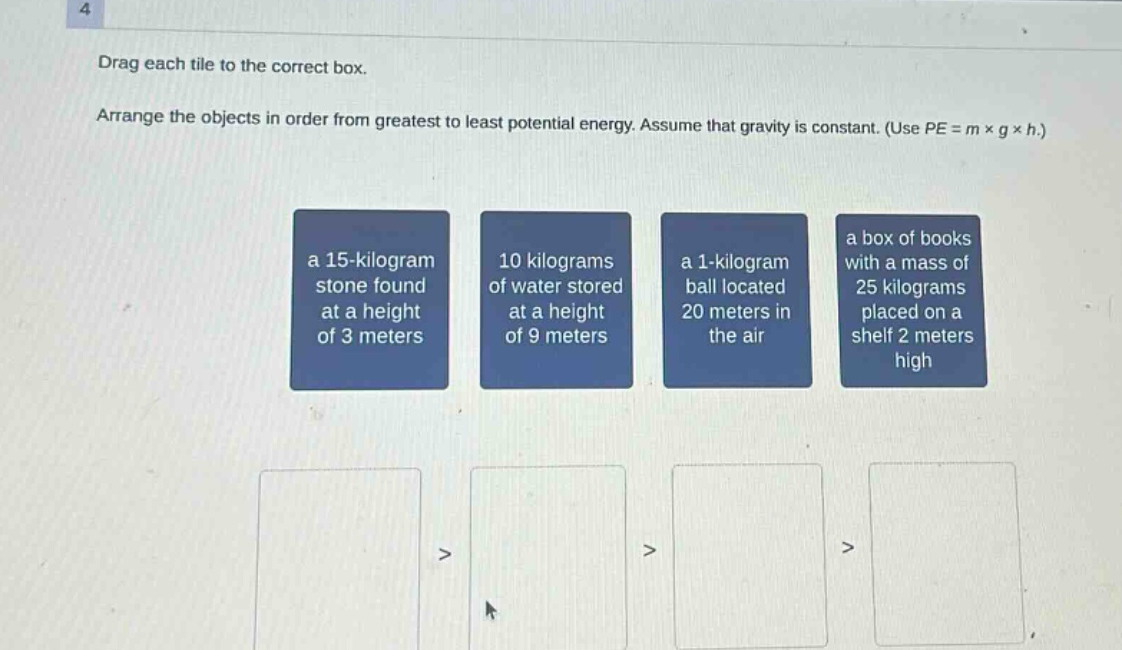
drag each tile to the correct box. arrange the objects in order from greatest to least potential energy. assume that gravity is constant. (use pe = m × g × h.) a 15 - kilogram stone found at a height of 3 meters 10 kilograms of water stored at a height of 9 meters a 1 - kilogram ball located 20 meters in the air a box of books with a mass of 25 kilograms placed on a shelf 2 meters high
Answer
Explanation:
Step1: Calculate PE for 15 - kg stone
Using $PE = m\times g\times h$, with $m = 15$ kg, $h = 3$ m. So $PE_1=15\times g\times3 = 45g$.
Step2: Calculate PE for 10 - kg water
Using $PE = m\times g\times h$, with $m = 10$ kg, $h = 9$ m. So $PE_2=10\times g\times9 = 90g$.
Step3: Calculate PE for 1 - kg ball
Using $PE = m\times g\times h$, with $m = 1$ kg, $h = 20$ m. So $PE_3=1\times g\times20 = 20g$.
Step4: Calculate PE for 25 - kg box of books
Using $PE = m\times g\times h$, with $m = 25$ kg, $h = 2$ m. So $PE_4=25\times g\times2 = 50g$.
Step5: Compare the potential energies
Since $90g>50g>45g>20g$, the order is 10 kilograms of water stored at a height of 9 meters > a box of books with a mass of 25 kilograms placed on a shelf 2 meters high > a 15 - kilogram stone found at a height of 3 meters > a 1 - kilogram ball located 20 meters in the air.
Answer:
10 kilograms of water stored at a height of 9 meters > a box of books with a mass of 25 kilograms placed on a shelf 2 meters high > a 15 - kilogram stone found at a height of 3 meters > a 1 - kilogram ball located 20 meters in the air