drag each tile to the correct box. waters specific heat capacity is 4.186 joules/gram degree celsius…
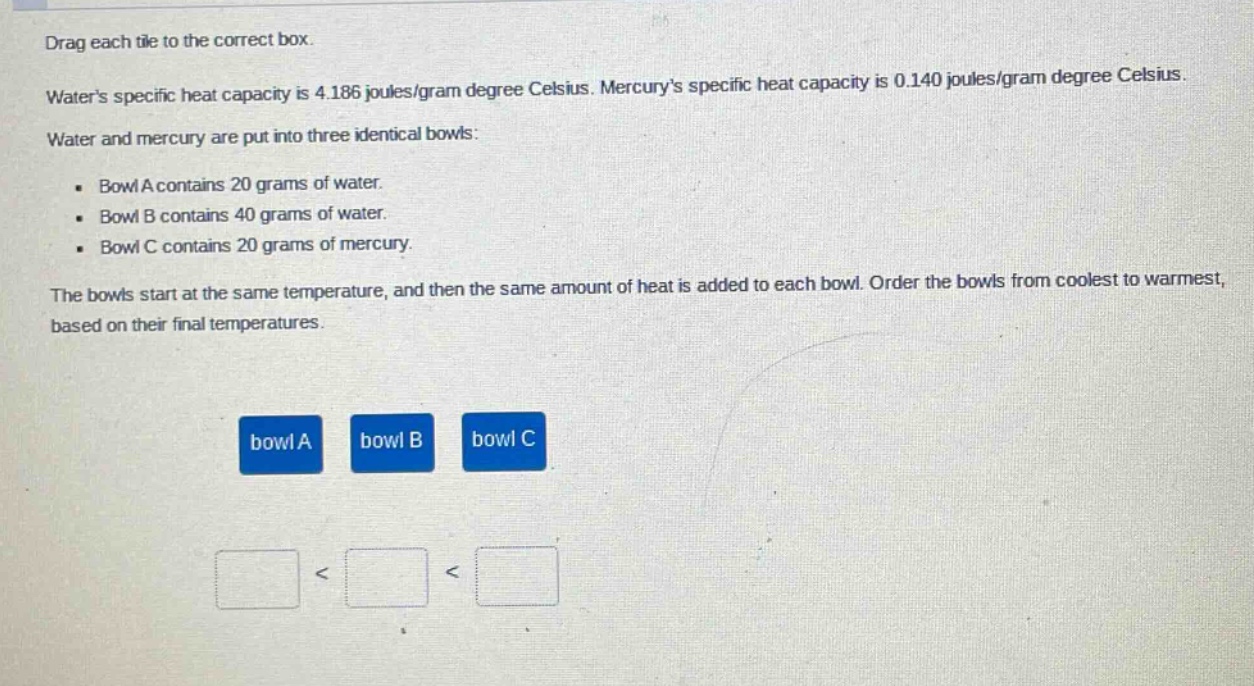
drag each tile to the correct box. waters specific heat capacity is 4.186 joules/gram degree celsius. mercurys specific heat capacity is 0.140 joules/gram degree celsius. water and mercury are put into three identical bowls: - bowl a contains 20 grams of water. - bowl b contains 40 grams of water. - bowl c contains 20 grams of mercury. the bowls start at the same temperature, and then the same amount of heat is added to each bowl. order the bowls from coolest to warmest, based on their final temperatures. bowl a bowl b bowl c
Answer
Explanation:
Step1: Recall heat - capacity formula
The formula for heat transfer is $Q = mc\Delta T$, where $Q$ is the heat added, $m$ is the mass, $c$ is the specific heat capacity, and $\Delta T$ is the change in temperature. We can re - arrange it to $\Delta T=\frac{Q}{mc}$. Since $Q$ is the same for all bowls, $\Delta T$ is inversely proportional to $mc$.
Step2: Calculate $mc$ for each bowl
For bowl A: $m_A = 20$ g and $c_{water}=4.186$ J/g°C, so $m_A c_{water}=20\times4.186 = 83.72$ J/°C. For bowl B: $m_B = 40$ g and $c_{water}=4.186$ J/g°C, so $m_B c_{water}=40\times4.186=167.44$ J/°C. For bowl C: $m_C = 20$ g and $c_{mercury}=0.140$ J/g°C, so $m_C c_{mercury}=20\times0.140 = 2.8$ J/°C.
Step3: Compare $\Delta T$ values
Since $\Delta T=\frac{Q}{mc}$ and $Q$ is constant, the larger the $mc$ value, the smaller the $\Delta T$. We have $m_B c_{water}>m_A c_{water}>m_C c_{mercury}$. So $\Delta T_B<\Delta T_A<\Delta T_C$.
Answer:
bowl B < bowl A < bowl C