drag each tile to the correct location. gas cloud 1 is likely to form a star. gas cloud 2 is not. based on…
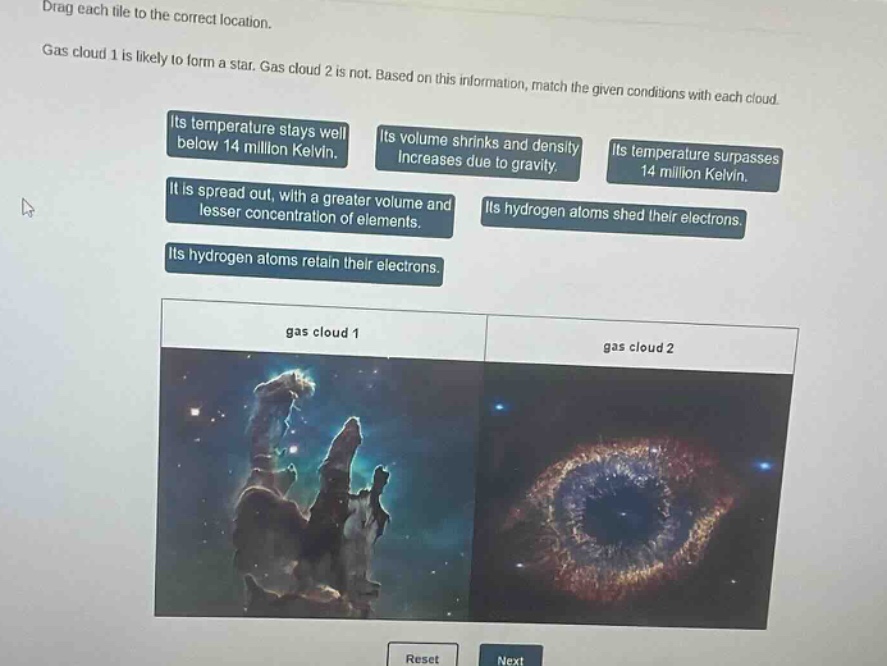
drag each tile to the correct location. gas cloud 1 is likely to form a star. gas cloud 2 is not. based on this information, match the given conditions with each cloud. its temperature stays well below 14 million kelvin. its volume shrinks and density increases due to gravity. its temperature surpasses 14 million kelvin. it is spread out, with a greater volume and lesser concentration of elements. its hydrogen atoms shed their electrons. its hydrogen atoms retain their electrons.
Answer
Brief Explanations:
A star - forming gas cloud (gas cloud 1) has its volume shrink and density increase due to gravity, its temperature surpasses 14 million Kelvin, and its hydrogen atoms shed their electrons. A non - star - forming gas cloud (gas cloud 2) has its temperature stay well below 14 million Kelvin, is spread out with a greater volume and lesser concentration of elements, and its hydrogen atoms retain their electrons.
Answer:
Gas cloud 1: Its volume shrinks and density increases due to gravity., Its temperature surpasses 14 million Kelvin., Its hydrogen atoms shed their electrons. Gas cloud 2: Its temperature stays well below 14 million Kelvin., It is spread out, with a greater volume and lesser concentration of elements., Its hydrogen atoms retain their electrons.